· Erin Calloway
Cat Slipped Out of the Harness Outdoors: What to Do in the First 10 Minutes
It happened to me once, in my second year of cat walking, with a strap harness I had not yet replaced: a van door slid open behind us, my middle cat folded her shoulders, and she was under the neighbor's porch steps before I had finished her name. This guide is the four minutes that followed, written down in order.
Minute zero: stop, drop, and use your feeding voice
Do not run after your cat: a chased cat runs farther and hides deeper. Stop, crouch, and leave the empty harness where it fell, since that spot is the center of your map. Call once in the voice your cat hears at dinner, then stop and listen.
A cat that has just slipped its harness is not exploring: it has run the shortest line to the nearest cover and is now crouched, silent, and watching, and a person sprinting toward it is the clearest threat it can see.
the distance within which three quarters of missing indoor-only cats were found, against 1,609 m for cats used to roaming, in a study of 1,210 lost cats
A harness-walked cat is an indoor cat, so yours is very probably within 450 feet of the harness, and usually much closer. Shouting the name over and over sounds like an alarm call. Use the word and pitch that mean food, at kitchen volume, then give the silence a chance: a hidden cat often answers with one small chirp.
Sit on the ground if you can, turn sideways, and drop your gaze. When the cat comes, let it arrive: hands low and open, the pick-up against your chest only once it is already touching you. A vest still hanging off one shoulder is the case covered in are cat harnesses escape proof; this guide is for the cat that is fully out of reach.
The treat bag, the carrier, and the door
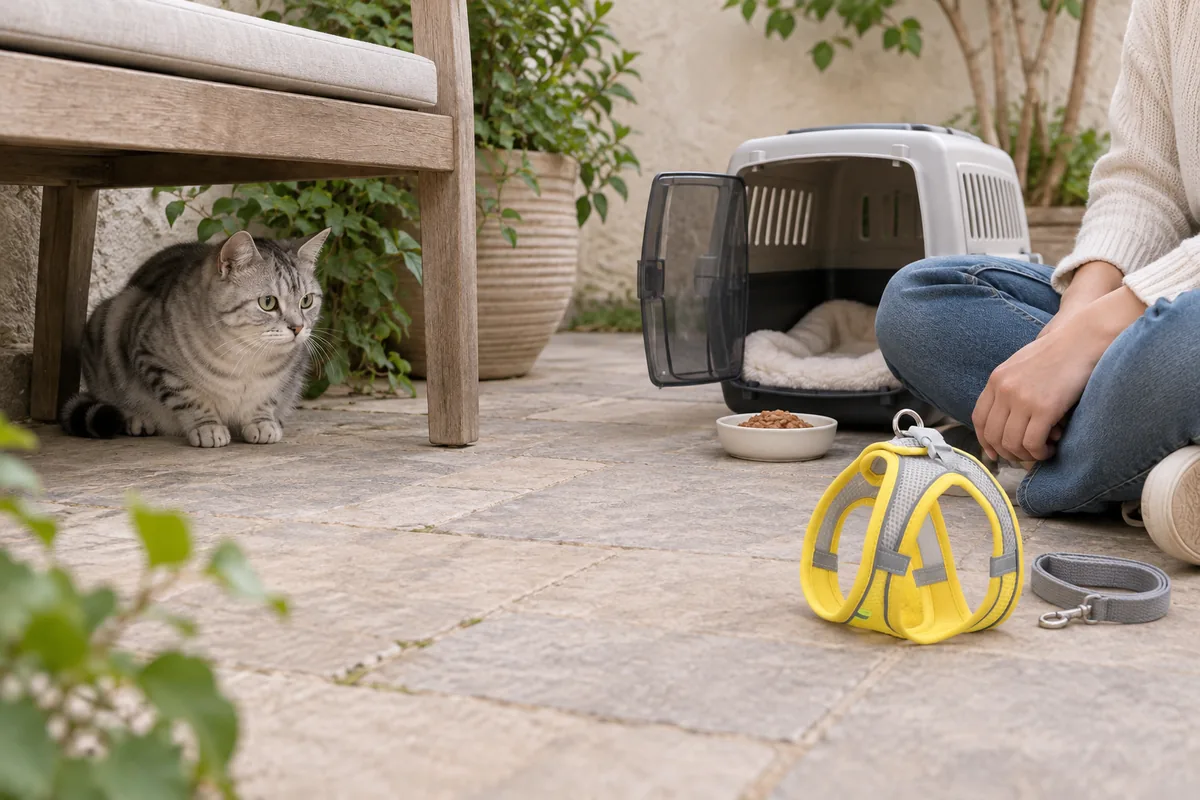
Sound and smell reach a cat that cannot see you. Shake the treat bag in the rhythm your cat knows from home, open a pouch of wet food upwind of the cover, set the carrier down open with its familiar blanket inside, then back away and wait.
The rattle of dry food is one of the most trained sounds in a cat's life, and it carries around corners. Shake, pause, shake again. Wet food works on the other sense: open it a few steps from the cover and let the wind do the rest. The carrier is the den: even a cat that fights it on vet day knows it as a familiar box, and many will walk into one they would never let you carry them toward.
Within sight of home, open your own door and stand aside: home is where a startled cat wants to go, which is why our first walk guide keeps early outings a few steps from the door. Farther out, the car does the same job: door open, carrier on the seat.
of recovered lost cats had come home on their own, in a telephone survey of 138 owners whose cats went missing over one summer
The ten-minute search grid after your cat slipped out of the harness
Search from the harness outward, low to the ground, in rings: first the cover you can touch, then every hiding place within about 50 meters, then the ring out to 150. A frightened cat goes under things.
| Ring | Radius from the harness | Where to look | How |
|---|---|---|---|
| 1 | 0 to 15 m (about 50 ft) | The nearest cover: steps, a hedge, under the closest car | Hands and knees, phone flashlight on even in daylight |
| 2 | 15 to 50 m (about 160 ft) | Decks, sheds, wood piles, wheel wells, gaps under fences | Slow arcs, stop and listen every few steps |
| 3 | 50 to 150 m (about 500 ft) | Open garages, crawl spaces, storm drains, dense planting | Ask neighbors to check their own sheds and garages |
| 4 | 150 to 500 m (about a third of a mile) | The same cover, one street further out | Only after rings 1 to 3, with someone still watching ring 1 |
The flashlight is not for darkness: a beam swept low under a car lights up a cat's eyes long before you can see the cat. Look up as well as under, since a startled cat will climb and then not know how to get down. Neighbors need one sentence: do not chase it, check under the hood before starting the car, and keep the dog in.
If the ten minutes pass without a cat, the search changes mode but does not stop: leave the open carrier and something that smells of you at the spot, come back at dusk and before dawn, when a hiding cat moves, report the cat to your local shelter the same day, and keep searching on foot every day that first week.
of 1,210 missing cats were back with their owner, alive, within seven days; the authors found evidence that physical searching raised the odds and recommend it in that first week
Once your cat is back in your arms
Carry your cat straight indoors or into the carrier before you deal with the harness, then look it over: paws, claws, mouth, belly, tail, and the way it walks. Bleeding, a limp, open-mouth breathing that does not settle, or a cat that refuses food past the next meal means a call to your vet.
Inside, set the cat down somewhere quiet and let it choose the next move; eating immediately and vanishing under the bed for an hour are both normal. Check the body once the breathing has slowed. A few minutes of panting after a sprint is usual; panting that continues once the cat is calm and cool is not, and neither is a limp, a wound, or a swelling. If your cat was hit, fell, or tangled with another animal, a same-day vet visit is the safe call even without a visible mark.
A cat frightened outdoors may flatten at the sight of the harness for days. Treat it as a cat that resists dressing: go back a stage, keep sessions short and indoors, and let food do the persuading, as in how to put on a cat harness. No walk happens until the harness is boring again and the cause of the slip is fixed.
Why your cat slipped out of the harness: slack, size, or shape
A slip has a trigger and a cause, and only the cause is yours to fix. The trigger was the van door or the dog. The cause is nearly always one of three: slack at the neck or chest, a size the cat has outgrown, or a strap shape that leaves the shoulders uncovered.
| What you saw | Likely cause | What to change |
|---|---|---|
| Came off over the head, still fully closed | Slack at the neck, or a vest a size too large | Re-measure against the size chart and refit to two fingers; a band at its tightest that still passes three fingers is the wrong size |
| The velcro peeled or the buckle popped | A fastener not fully seated, fur in the velcro, or one closure doing all the work | Press the velcro flat with no fur under it, snap the buckle over it, peel-test weekly |
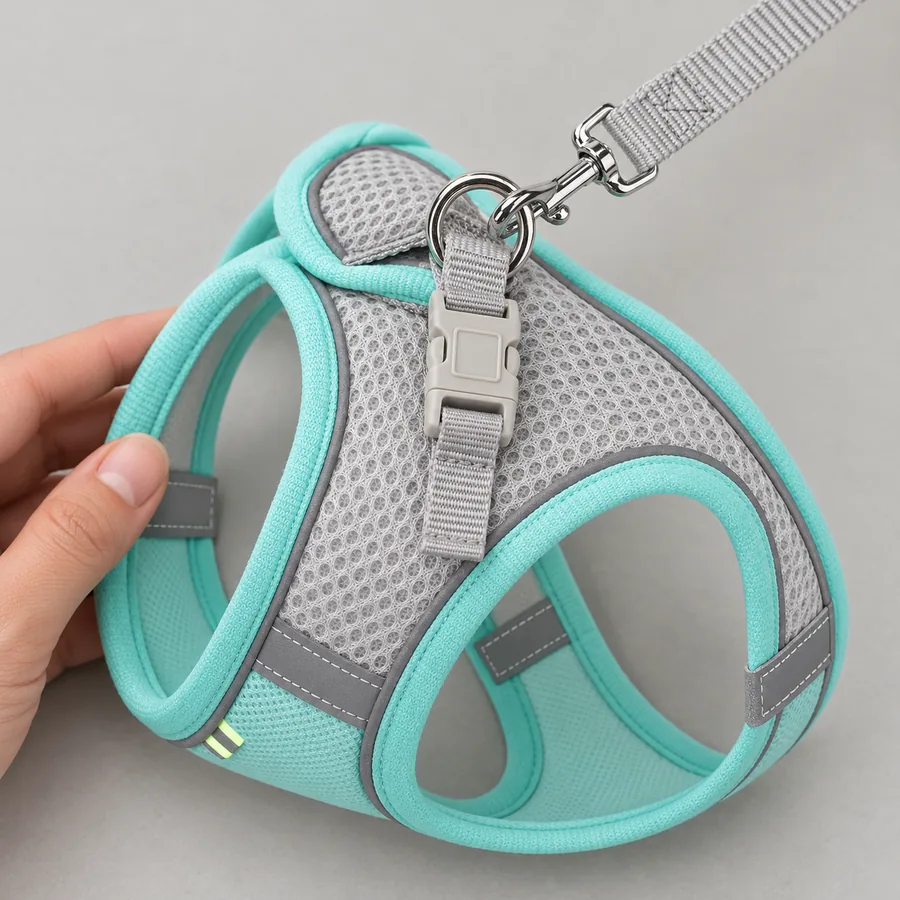
| The cat reversed out between two straps | Open space between the loops at the shoulders | A wrap vest closes that space with fabric |
| It fit last month and not today | A growing kitten, or an adult that changed weight | Weekly fit check on kittens, a re-measure after any weight change on adults |
The first row is the common one: a neck that admits three fingers instead of two feels comfortable and is in fact an open door. The mechanics of the reverse are laid out in how cats actually get out of harnesses, and why a panel holds a backing cat where two straps do not is the subject of cat harness types.
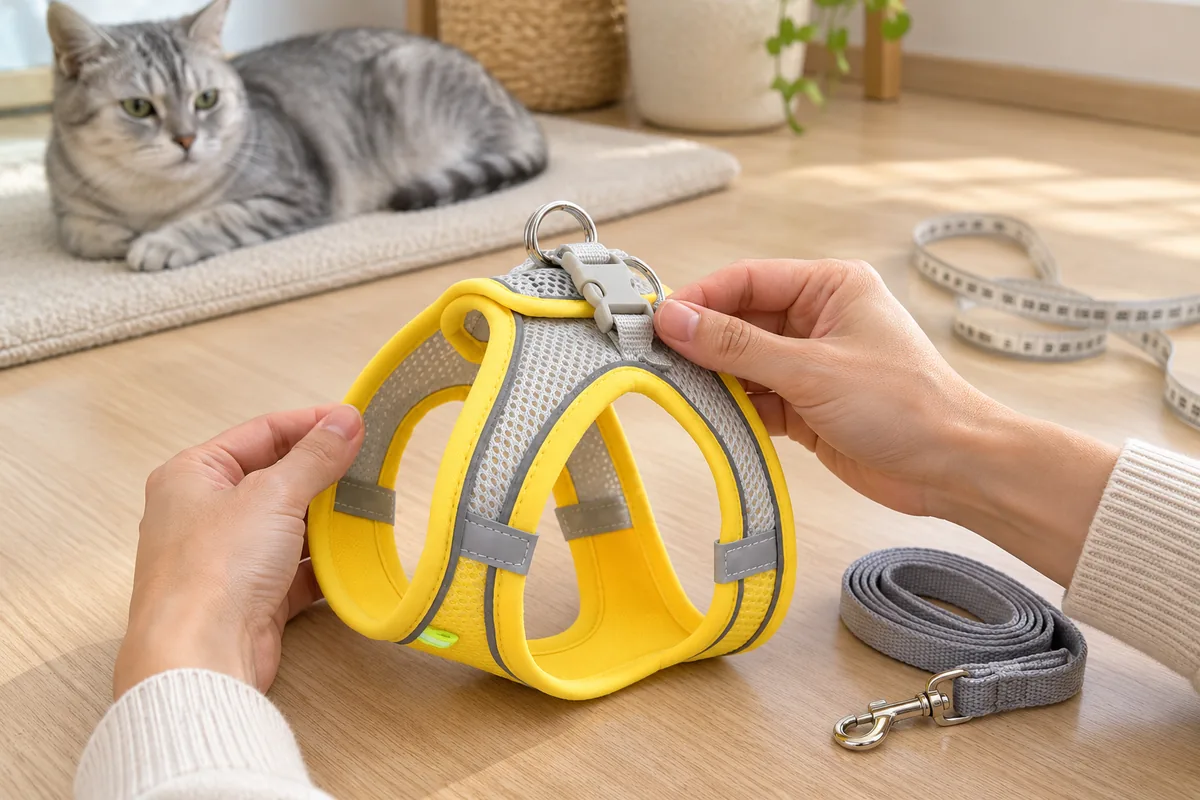
Our own design answers each row. The Escapaw harness is a mesh wrap vest, so there is no gap between straps for a shoulder to fold through. Its velcro band sets the circumference and a buckle clip locks over it, so a peeled corner of velcro on its own leaves the vest shut: two closures have to fail, not one. Five sizes cover 0.5 to 15 kg (1.1 to 33 lb), sized by weight against the chart. And still, no cat is 100% Houdini-proof, so every outdoor minute stays supervised. It holds 4.8 out of 5 across 186 verified reviews.
Kittens get the last row because they defeat last month's fit by growing; the re-measuring schedule for a growing cat is on the kitten harness page.
Before the next walk
Treat the first outing after a slip as a first walk again: re-measure, refit, run the two-finger check at neck and chest, and go back to a few minutes in the enclosed spot by your door. Confidence comes back in days when the outing stays small and ends on a treat.
Rehearse the recovery indoors so it works outdoors: the feeding word, the treat-bag rattle, and the open carrier, each paired with food. Keep the treat bag in the kit and the carrier in the car, and run the thirty-second pre-walk gear check every time. Give the cat something to be found by, too: only 19% of the missing cats in the survey above carried any identification, and a harness carries none. A breakaway collar with an ID tag under the vest, plus a microchip with current details, is the two-piece setup in cat harness vs collar.
Cat slipped out of the harness FAQ
How far does a cat go after slipping its harness?
Usually not far. In a study of 1,210 lost cats, three quarters were found within 500 m of the escape point, and indoor-only cats within 137 m at the same percentile. Search the nearest cover first.
Should I run after my cat if I can still see it?
No. Running triggers flight and pushes the cat past the nearest cover into the next one. Stop, crouch, turn sideways, use your feeding voice, and let the cat cross the last few yards on its own.
What should I carry on a walk in case my cat slips the harness?
The treat bag you already use, your phone for its flashlight, and on any outing beyond the yard, the carrier in the car with a familiar blanket. Under the harness, a breakaway collar with an ID tag and a microchip with current details.
My cat slipped the harness once. Will it happen again?
It becomes far less likely once the cause is removed: slack, a size the cat has outgrown, or open strap geometry. Refit to two fingers, use a wrap vest with a double closure, and run the gear check before every walk. No cat is 100% Houdini-proof, so supervision stays part of every outing.
Free shipping · 30-day returns