· Erin Calloway
Cat Harness Types: H-Harness, Vest and Full-Body Compared
Product listings invent names faster than anyone can learn them: step-in, jacket, butterfly, figure-eight. Underneath the labels there are only three shapes, and the shape tells you where leash force lands, how much handling dressing takes, and how much room a startled cat has to work backwards. This guide maps all three.
One job, three shapes
A harness type is defined by four things: coverage, where the leash ring sits, how it closes, and the path it takes onto the cat. Sort any harness on those axes and it lands in one of three families, whatever the listing calls it.
Coverage is the axis that drives the other three: add fabric and you spread pressure wider, close off reversing room, and lengthen the dressing routine; remove fabric and everything runs the other way. Every design is a point on the line between two straps and a garment.
One boundary first: a collar is not a harness type. It circles the neck, carries identification, and is built to release when snagged, which disqualifies it from leash duty; the full comparison is in cat harness vs collar.
The H-harness: two loops and a spine strap
The H-harness is the minimal geometry: one loop around the neck, one around the chest behind the front legs, joined by a short strap along the spine and often a second under the sternum. Seen from the side it draws the letter H. Contact with the body is the width of the straps.
Everything people like about the H-harness follows from how little of it there is. It is the lightest type, the coolest in warm weather, and the least fabric a touch-sensitive cat has to accept: cats who flatten under a vest will often walk normally in an H.
The geometry also fixes its limits. Leash force arrives on two narrow lines rather than a surface, so a hard pull concentrates instead of spreading. And between the neck loop and the chest loop sits open space: the shoulders are uncovered by design. Step-in and figure-eight variants change the entry path, but neither closes that space; it is the signature of the family.
The vest: a panel instead of straps
The vest replaces the strap skeleton with a fabric panel that wraps the chest from the base of the neck to behind the ribs, with two openings for the front legs. It closes over the back, with the leash ring between the shoulder blades on top of that closure.
The wrap changes the physics: force an H-harness delivers along two lines spreads across the whole chest panel, so a lunge barely registers inside a fitted vest. The panel also occupies the space an H leaves open: no gap between loops because there are no loops, only one continuous surface with leg holes.
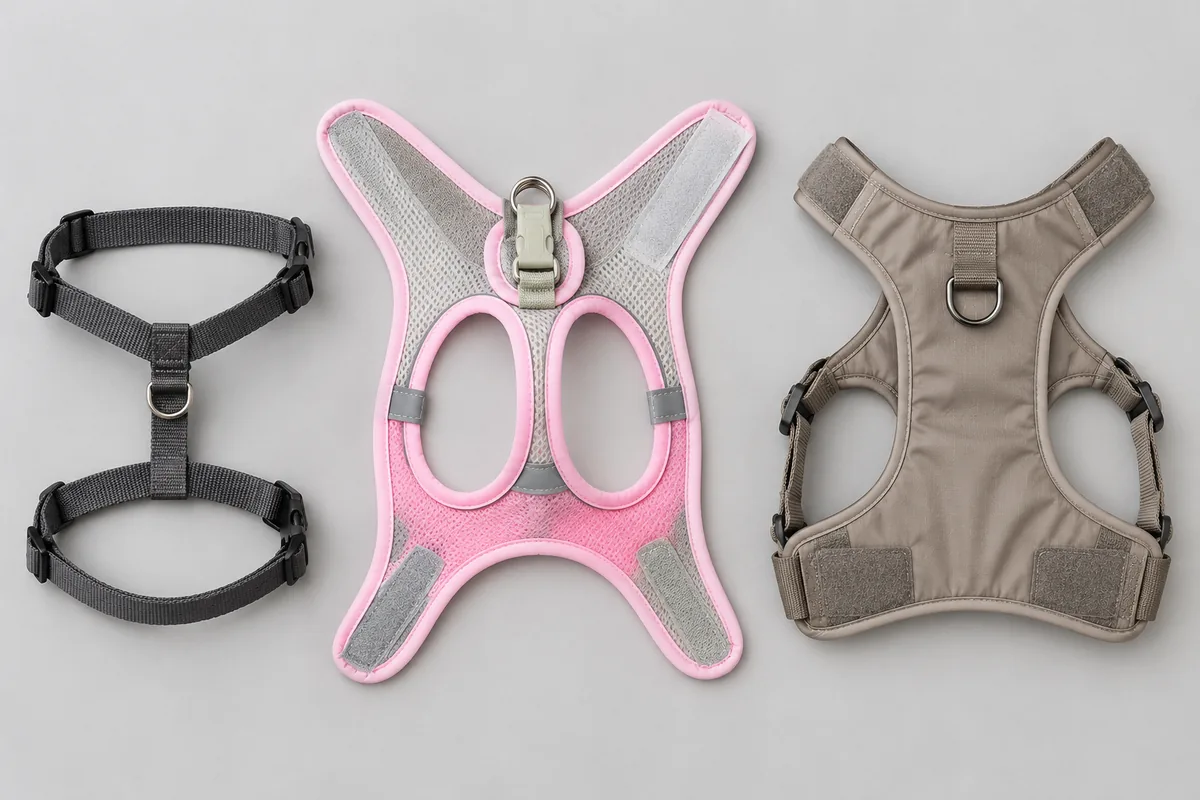
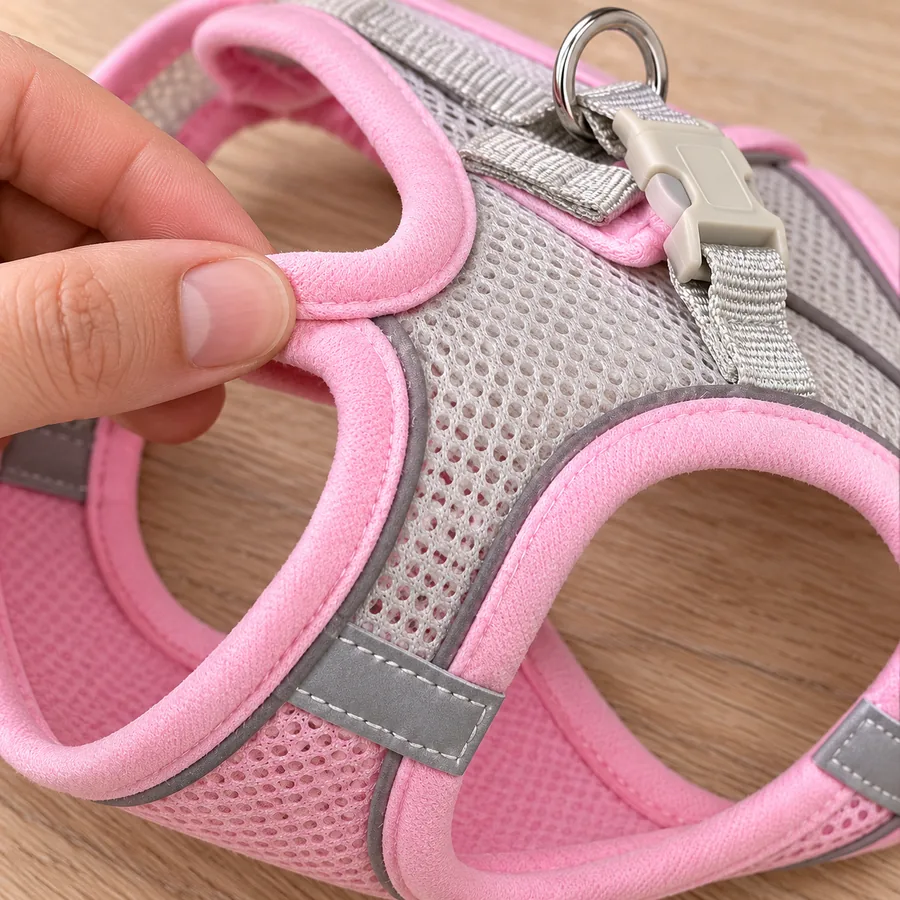
Fabric choice decides how the type wears. A solid-cloth vest holds warmth; an open mesh weave lets air cross the chest and keeps a summer walk comfortable. Closures vary within the family too: velcro alone, buckles alone, or both stacked. Our own Escapaw harness is this type, a breathable mesh vest where a velcro band sets the circumference and a buckle clip locks over it, so the panel needs two separate failures before it opens.
The full-body harness: coverage past the ribs
The full-body harness, often sold as a walking jacket, is the vest geometry extended: the panel continues down the spine past the ribcage, usually with a wider closure and sometimes a second one behind the ribs. It covers the most body of any type, and it asks the most of the cat wearing it.
More panel means more surface gripping the torso, and the longer cut leaves the least room of any type for shoulders to fold and slide free. For a cat with a proven talent for working out of gear, this is the shape that answers it.
The costs scale with the fabric: it is the warmest type, the heaviest, and the slowest to put on. Cats who accept a vest in one session can need days of patient work before a jacket stops triggering the flop. It is a specialist's shape, the right call for a specific cat, not a default.
Where the pressure lands on each type
Under the same leash pull, the H-harness loads two strap lines at the sternum and withers, the vest the whole chest panel, and the full-body chest and mid-back together. Contact area is the number that moves everything else.
| H-harness | Vest | Full-body | |
|---|---|---|---|
| Contact with the body | Strap-width lines | Chest panel | Chest and back panel |
| A pull is felt as | Two pressure lines | Spread across the chest | Spread across the torso |
| Open space at the shoulders | Yes, between the loops | No, panel covers it | No, panel extends past it |
| Airflow | Maximum | High with mesh | Lowest |
| Dressing path | Head through, straps aligned | Lay flat, wrap, close | Wrap plus extra fasteners |
All three types put the leash ring between the shoulder blades, so a sudden pull rotates the cat rather than wrenching the neck. What differs is what surrounds it: on an H-harness the ring rides on a strap junction that can shift under load; on the panel types it is sewn into fabric the pull presses flatter against the body.
What each type asks at dressing time
The three types take three paths onto the cat. An H-harness passes over the head, then buckles behind the legs. A vest lays flat, takes the two front paws through its own leg openings, and closes over the back in one wrap. A full-body harness wraps the same way, with more fabric to seat and more fasteners to close.
Which path your cat tolerates matters more than any spec, because a harness that starts a chase does not get used. Heads are the sticking point: many cats object to anything passed over the face, which is the H-harness entry, and the step-in variant trades that problem for aligning two leg holes. The vest avoids both, which is why we hand it to first-timers; the full sequence, with the two-finger fit check at neck and chest, is in how to put on a cat harness.
Whatever the type, dressing lands faster when the gear is introduced early, in short indoor sessions with treats; the staged plan is in how to harness train a cat.
Which type holds a cat that backs up
A reversing cat plants its front feet, drops its shoulders, and slides backwards, aiming to pass the front of the harness over the folded shoulders. The H-harness offers that move an open route between its loops. The vest closes the route with fabric. The full-body adds length on top.
The reverse is the escape that matters, because it is the one cats are anatomically built for: the shoulder blades float on muscle rather than bracing against a rigid collarbone, so the front end compresses more than it looks like it should. Against that move, strap geometry is the wrong tool: an H-harness neck loop only has to clear two folded shoulders, and the space between its loops hands the cat the slack to start.
Panel geometry resists it structurally. A fitted vest gives the shoulders nowhere to go, provided the fit is snug and the closure keeps the circumference under a backward pull. That second condition is why ours stacks a buckle clip over the velcro band. A full-body harness resists hardest of all, simply by having the most garment to defeat. No type is infallible; how much to rely on each design, and what to do in the seconds after a slip, is the subject of are cat harnesses escape proof.
Matching the shape to the cat in front of you
Pick the type by the cat, not the catalog. A calm, leash-experienced cat in a quiet space can wear the light H-harness. Most cats, and every first-timer, are better served by a wrap vest. A determined reverser needs a snug vest with a double closure, or a full-body in cool weather.
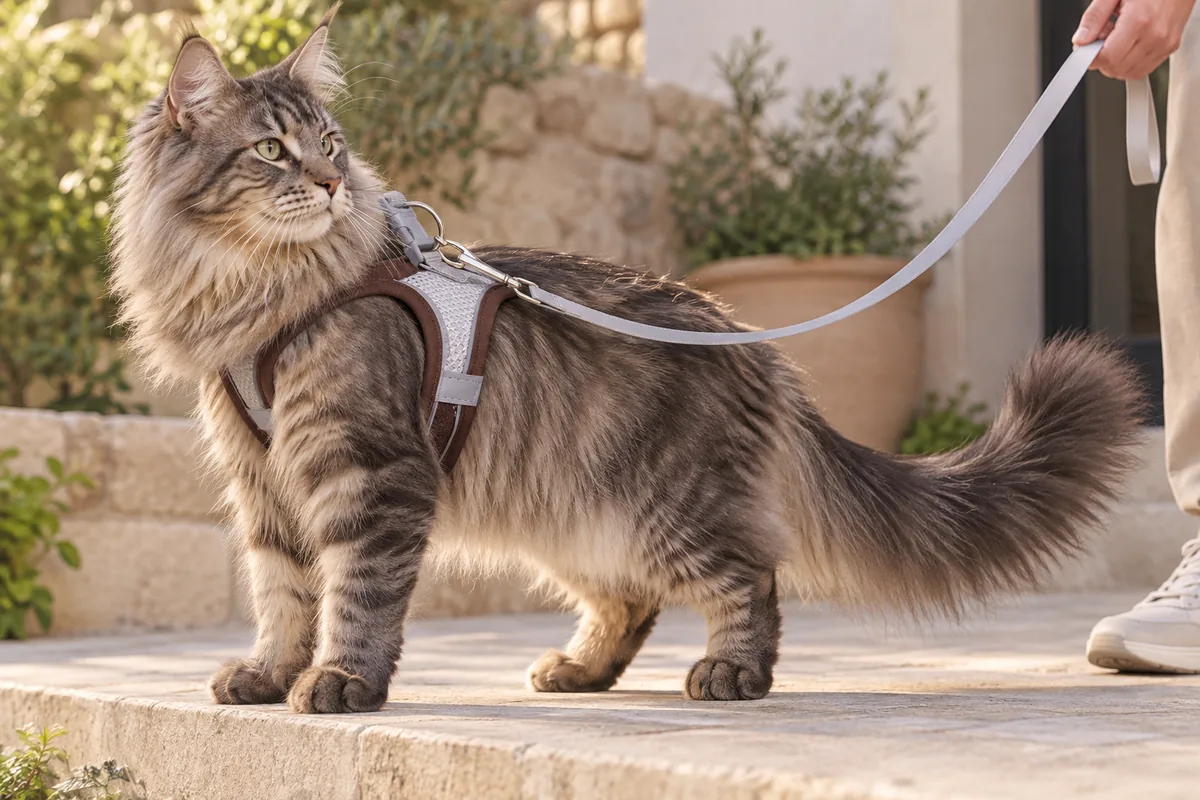
Between those two extremes sits nearly every cat we meet, and that middle is where our product lives. The Escapaw harness is a mesh vest with padded edges and reflective strips: panel coverage that shuts the reversing route, airflow that survives July, and a lay-flat dressing path. The velcro band plus buckle clip closure keeps the circumference under a backward pull, the leash clips to a reinforced metal D-ring, and five sizes cover 1.1 to 33 lb (0.5 to 15 kg) at 69 to 90 grams of vest. It holds 4.8 out of 5 across 186 verified reviews.
Two profiles sit outside the standard chart. Kittens change size too fast for any type to fit for long, so they get their own timeline and re-measuring schedule on the kitten harness page. The big breeds stretch the top of every size run, where a vest panel has to close around a genuinely wide chest.
weight a mature male Maine Coon commonly reaches or exceeds, per the breed's official profile, the top of the range a size L must fit
— The Cat Fanciers' Association, 2025
For those cats the lesson is the same at scale: coverage holds, straps gap, and fit decides between them; the sizing detail lives in the cat harness for large cats guide. Whatever the shape, introduce it indoors before the first walk, and let the cat, not the label, confirm the choice.
Cat harness types FAQ
Is an H-harness safe for walking a cat outside?
In a quiet, enclosed space, on a calm cat who already knows the leash, yes. Anywhere a startle is possible, the open space between its strap loops is the route a frightened cat reverses through; a wrap design that closes that space is the better tool.
What is the difference between a vest harness and a full-body harness?
Coverage. A vest wraps the chest and closes over the back, ending near the ribs. A full-body harness carries that fabric further down the spine, sometimes with a second closure behind the ribcage. The extra material adds security, and also warmth, weight, and dressing time.
Which cat harness type is easiest to put on?
The vest, for most cats. It opens flat, so you lay it down, put a front paw through each of its two leg openings, and close it over the back, with no loop to pass over the head. An H-harness has less material but asks you to thread the head and align straps.
Can I switch my cat between harness types?
Yes, but treat the new shape as new gear. A cat that accepts an H-harness has learned two thin straps, not a fabric panel, so give the new type a few short indoor sessions before a walk, and run the two-finger fit check the first time it goes on.
Free shipping · 30-day returns