The Best Cat Harness by Type, and the One We Sell
Most "best cat harness" roundups list ten products and commit to none of them. Escapaw is one harness, a mesh vest, and not every type suits every cat. This guide explains the three harness types, scores them on the four criteria that decide whether a walk happens or a cat vanishes under the couch, and shows where our own escape proof cat harness wins and where a different type would serve you better. Every size recommendation here follows the same weight chart as the rest of the site.
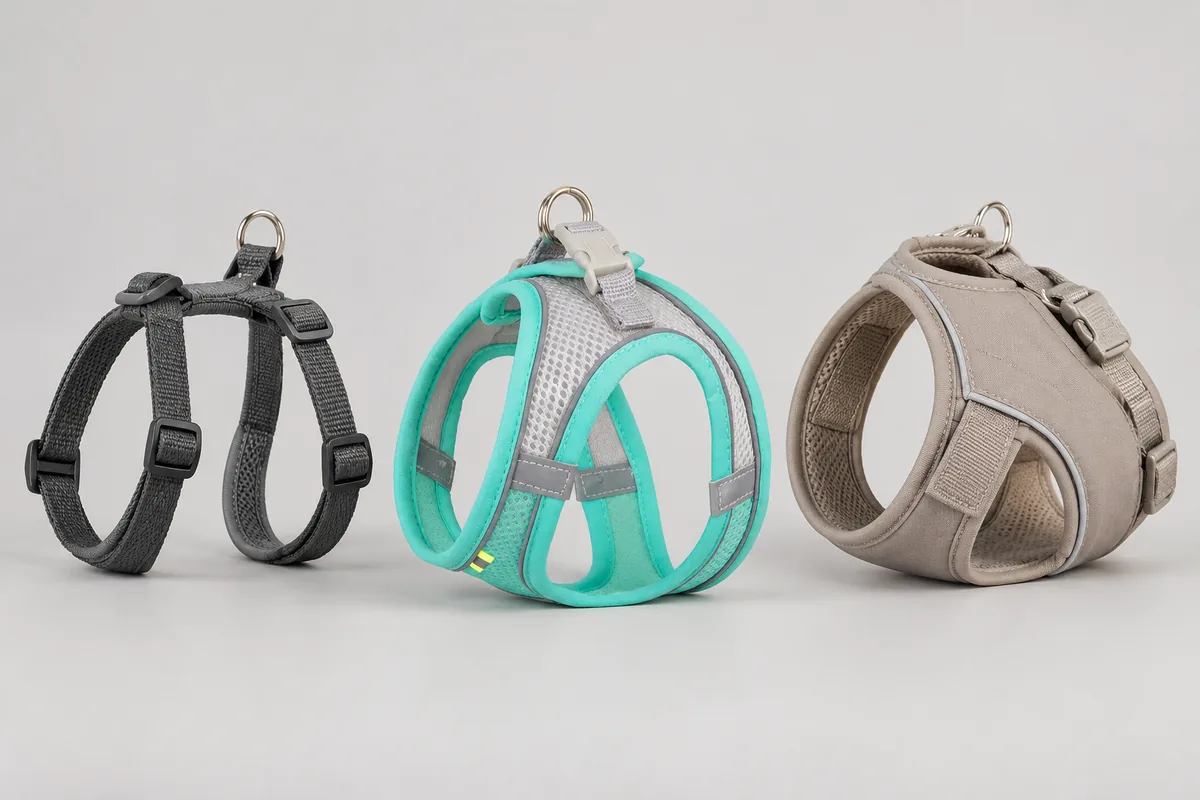
The three cat harness types, compared
Cat harnesses come in three basic designs: the H-style strap harness, the mesh vest, and the full-coverage jacket. They trade off between escape resistance, weight, breathability, and how much handling your cat must tolerate while being dressed. The table below scores each type on what actually matters.
| Type | Escape resistance | Ease of dressing | Breathability | Best suited to |
|---|---|---|---|---|
| H-style straps | Low, straps leave gaps a cat can reverse through | Easy, minimal contact | Excellent, mostly open | Calm, harness-experienced cats on short outings |
| Mesh vest (our pick) | High with a snug fit and double closure | Easy, lays flat then wraps | Very good, open mesh weave | Most cats, from first-timers to daily walkers |
| Full-coverage jacket | Highest, wraps the most body area | Slower, more handling to fit | Limited, solid fabric runs warm | Proven escape artists who have beaten a vest |
H-style strap harness
The H-style is the minimalist option: two loops joined by a spine strap, forming an H over the shoulders. It is light, cool, and quick to clip on, and cats who dislike fabric on their body often tolerate it best. The weakness is structural. Because the design touches so little of the body, a cat that plants her front legs and reverses can fold her shoulders through the front loop. For a mellow, experienced cat on a quiet porch, an H-style is fine. For a twitchy first-timer near a road, it is the wrong tool.
Mesh vest harness
The vest replaces straps with a panel of breathable mesh that wraps the chest and closes over the back. Pressure spreads across the whole chest instead of two narrow lines, there is no gap between straps to reverse through, and dressing is a single lay-flat, wrap, and clip sequence most cats accept after a few sessions with treats. The Escapaw vest uses this format, with padded edges, reflective strips, and a reinforced metal D-ring. Our dressing guide shows the full sequence in photos.
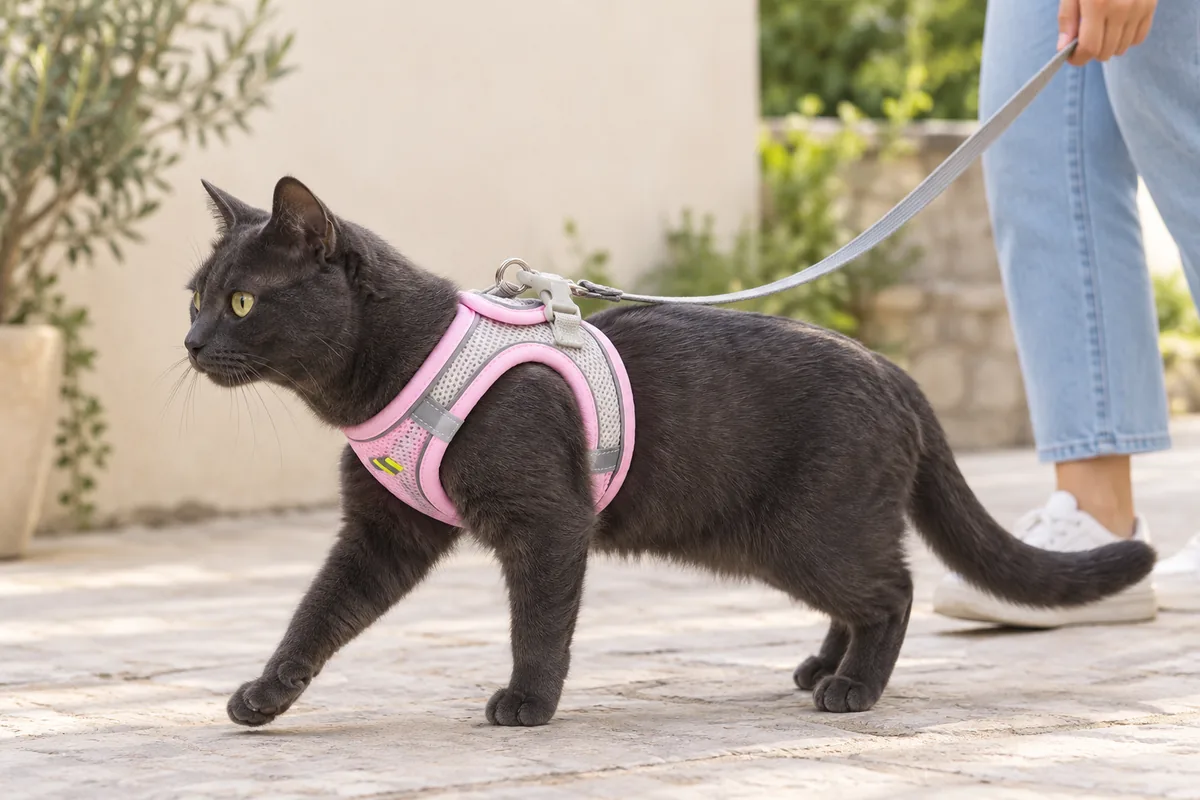
Full-coverage jacket harness
The jacket extends coverage further down the body and typically adds wider closures. It is the hardest design for a cat to escape, and for known Houdinis that is the deciding argument. The tradeoffs are real, though. Solid fabric holds heat in summer, the extra material adds weight, and the longer dressing process is exactly the kind of handling that makes reluctant cats disappear when the harness comes out. Choose a jacket when escape history demands it, not as a default.
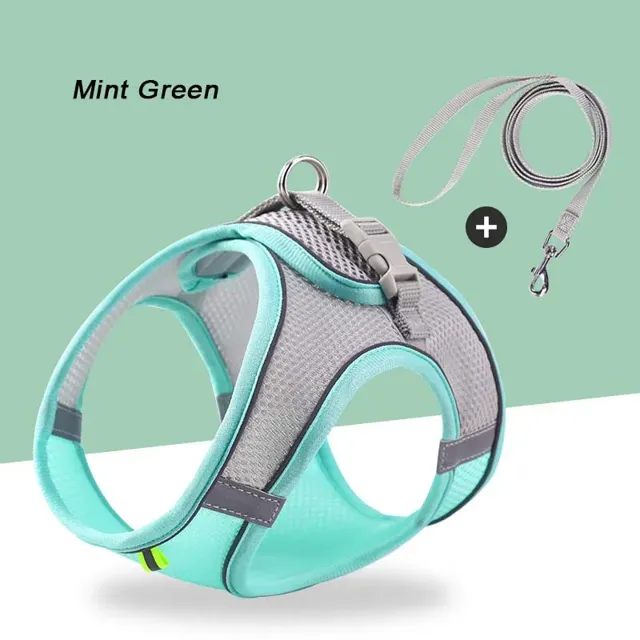
Escapaw Cat Harness & Leash Set
★ 4.8/5 · 186 verified reviews · $49.95 $29.95
The four criteria that separate the best from the rest
Judge any cat harness on four things: how it resists escape, how quickly it goes on, how comfortable it stays through a full walk, and how visible it keeps your cat in low light. A harness that fails any one of these tends to end up in a drawer by the second week.
1. Escape resistance you can explain
Marketing words are cheap, so look for mechanisms. On the Escapaw vest the escape resistance comes from three specific parts: a snug wrap with no strap gaps, a double closure where a buckle clip locks over the velcro band so both must fail before the vest opens, and a reinforced metal D-ring that takes a lunge without deforming. The short version still holds: no cat is 100% Houdini-proof, so supervise every outdoor minute. The full answer is in are cat harnesses escape proof.
2. Ease of putting it on
A harness only works if the dressing ritual does not become a chase. Vests win here because they open completely flat: you lay the mesh on the floor, put a front paw through each of its two leg openings, wrap, and close. There is no loop to thread a reluctant head through at an awkward angle. With a slow introduction, most cats stop reacting to the vest within days, and the harness training guide gives you the exact treat-timing sequence.
3. Comfort your cat will vote on
Cats vote with their bodies. A harness that pinches produces the famous flop, freeze, or crab-walk. Breathable mesh, padded edges at every contact point, and a total weight of 69 to 90 grams depending on size keep the Escapaw vest under the threshold most cats bother protesting. Fit matters as much as materials: order by weight, and when your cat sits between sizes, take the larger and let the velcro band pull the fit snug.
4. Visibility after sundown
Cat walks drift toward dawn and dusk, when cats are most active and streets are dimmest. Reflective strips on the vest body return headlight beams to their source, turning a shadow at ankle height into a bright outline. The Pink, Mint Green, and Yellow colorways are easy to spot in daylight too, which helps you keep visual contact when your cat slips behind a shrub. You can see how each color looks on real cats in our verified reviews.
Our pick, including who it is not for
For most cats, from first-timers to daily walkers, our pick is the mesh vest. It is not the right choice for cats who have already escaped a well-fitted vest, and it does not fit kittens under 1.1 lb (0.5 kg). The sizes, weights and closure are set out below.
Five sizes cover an 11 to 24.4 in (28 to 62 cm) chest, with the vest itself weighing 69 g in XS, 74 g in S, 80 g in M, and 90 g in L. The closure sequence is the detail that earns trust: the velcro band sets the fit first, then the buckle clip locks over it, so a peeled velcro corner alone never opens the vest. One buyer summed up the M in five short beats: "Very good product, does the job, fits well, excellent quality."
| Design | Mesh vest, padded edges, reflective strips |
| Closure | Double: velcro band plus buckle clip |
| Leash attachment | Reinforced metal D-ring, back-mounted |
| Included leash | 59 in (150 cm), matched lightweight webbing, all sizes |
Fit is what settles it. A cat reverses out of a harness when the chest circumference opens under a backward pull, which is the exact job of the double closure: the velcro band sets the circumference, the buckle clip locks over it, and a peeled velcro corner on its own leaves the vest shut. Snug it to two fingers of clearance at the chest and re-check it before each walk. Kittens from 1.1 lb (0.5 kg) start in the XXS, and our kitten harness guide covers them while they grow. Big cats are well inside it: the L fits 22 to 33 lb comfortably, with details in the large cats guide. At $29.95 the complete cat harness and leash set includes the 59 in (150 cm) matched leash in every size.
Verified reviews.
Cat harness demand by the numbers
The surge in cat ownership explains why harness options multiplied so fast, and the safety numbers explain why walking on a leash beats free roaming. More households than ever live with cats, indoor cats live years longer, and supervised walks spare local wildlife entirely.
US households own a cat per the 2025 APPA Dog & Cat Report, a record after a 23% jump in a single year
typical indoor cat lifespan, against 2 to 5 years for unsupervised outdoor cats
small mammals killed each year in the US by free-ranging cats, on top of billions of birds
Free shipping · 30-day returns · Dispatched within 1-2 business days
Launch pricing saves $20 per set and will not stay around forever.
Best cat harness FAQ
What type of cat harness is hardest to escape from?
A full-coverage jacket harness offers the most escape resistance because it wraps the largest area of the body. A well-fitted mesh vest with a double closure comes close while staying lighter and cooler. H-style strap harnesses are the easiest to back out of, because a determined cat can reverse through the gap between the straps.
Is a mesh vest harness good for summer?
Yes, mesh is the fabric to pick for warm weather. The open weave lets air move across the chest and back instead of trapping heat the way a solid fabric jacket does. The Escapaw vest weighs only 69 to 90 grams depending on size, so it adds warmth and weight your cat will barely notice.
What size cat harness should I order?
Order by weight: XS fits 3.3 to 6.6 lb (1.5 to 3 kg), S fits 6.6 to 13 lb (3 to 6 kg), M fits 13 to 22 lb (6 to 10 kg), and L fits 22 to 33 lb (10 to 15 kg). Sizing is hand-measured with a 0.5 to 1 in (1 to 3 cm) allowance, so if your cat lands between two sizes, always take the larger one and let the velcro band fine-tune the fit.
What if the harness does not work out for my cat?
Every Escapaw set is covered by 30-day returns with free shipping both ways. Orders are dispatched within 1-2 business days and arrive in 6-10 business days, which leaves you plenty of the return window to test the fit through real training sessions at home before deciding.
Written by Erin Calloway, cat guardian and harness-training practitioner. Browse the complete set guide next.