· Erin Calloway
How to Harness Train a Cat
The first time I put a harness on my oldest cat, she fell over sideways and lay there as if the vest weighed forty pounds. That reaction is so common it has a nickname among cat people: the flop. It is also completely reversible with patient, food-driven training.
I have harness-trained three cats over the past eight years, and every one of them started with some version of the flop. The plan below is the one I now use from day one. It works because it never asks the cat to accept more than one small change at a time.
Why harness training starts indoors
Indoors is where your cat feels safe, so that is where the harness must become boring first. Training inside removes every outdoor variable, lets you end sessions instantly, and builds a calm association between the vest, treats, and normal life before you ever touch a door handle.
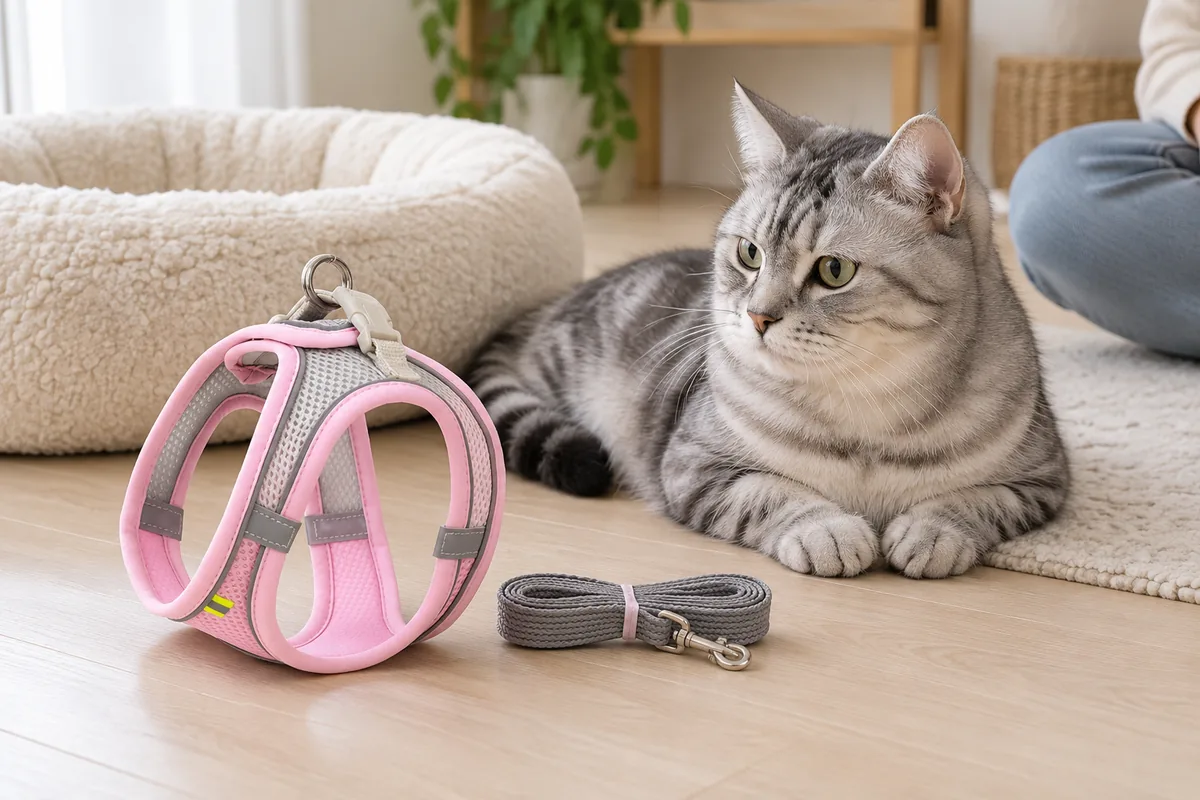
Skipping the indoor phase is the single most common reason harness training fails. Outside, every new smell and sound competes for your cat's attention, and fear has a hundred directions to run. Inside, the harness is the only new thing in the room, and your cat already knows every hiding spot is safe.
U.S. households own a cat, up from 40 million in 2023, according to the industry's national ownership report
Cat ownership keeps climbing, and a growing share of those households want safe outdoor time for their cats. Harness walking is how careful owners deliver it, but the habit is built in the living room weeks before it reaches a sidewalk. The door stays shut until the harness is thoroughly boring.
Indoors also protects your timeline. If a session goes wrong inside, you take the vest off, hand over a treat, and try again tomorrow. If a session goes wrong outside, your cat can bolt, and one bad scare can undo weeks of progress. Our first walk outside guide covers the transition when the time comes.
The step-by-step training plan
Work through five stages: scent introduction, treat association, draping the open harness, fastening it for seconds at a time, then wearing it through play and meals. Move to the next stage only after your cat stays relaxed at the current one for two or three sessions in a row.
Stage 1: Let the harness live in the room
Leave the harness on the floor near a favorite resting spot for a few days. Let your cat sniff it, walk past it, and ignore it. You are not training anything yet. You are letting the object stop being news.
Stage 2: Make it a good omen
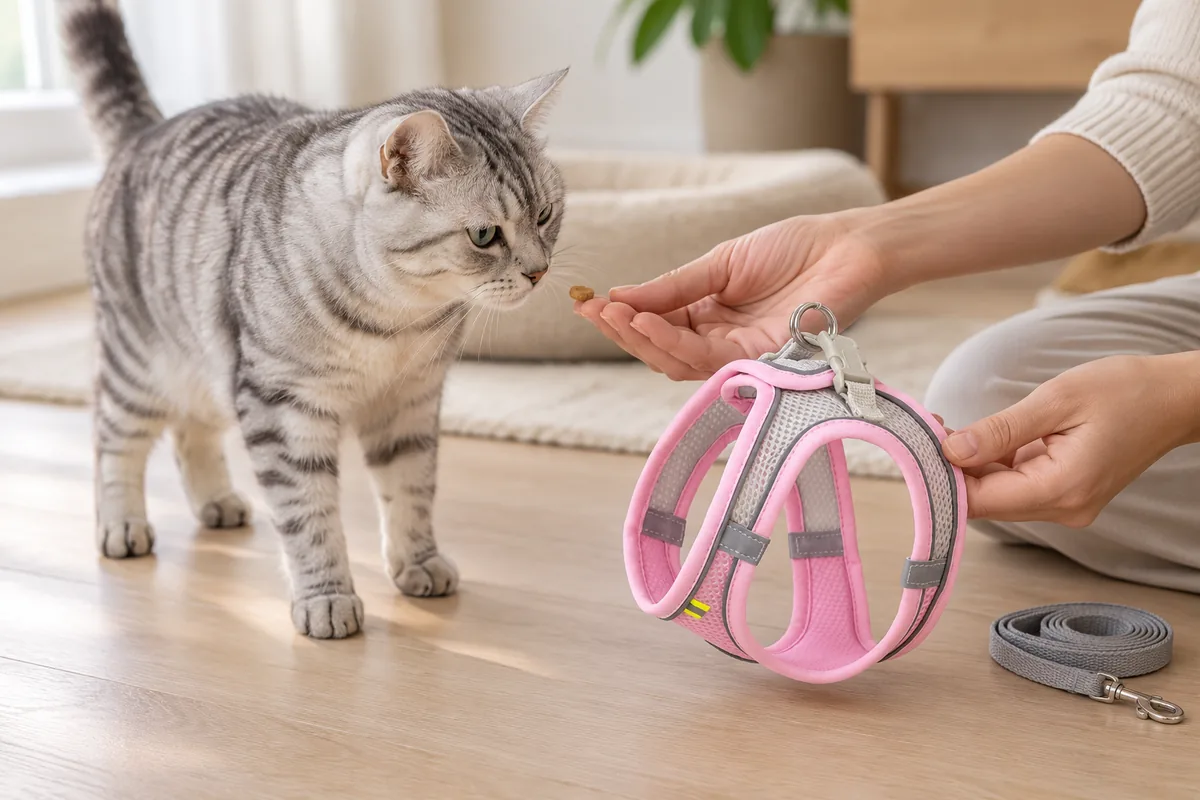
Pick up the harness, put it down near your cat, and immediately offer a high-value treat. Repeat in short bursts over a couple of days. The goal is a simple equation in your cat's head: when the harness appears, good things happen.
Stage 3: Drape without fastening
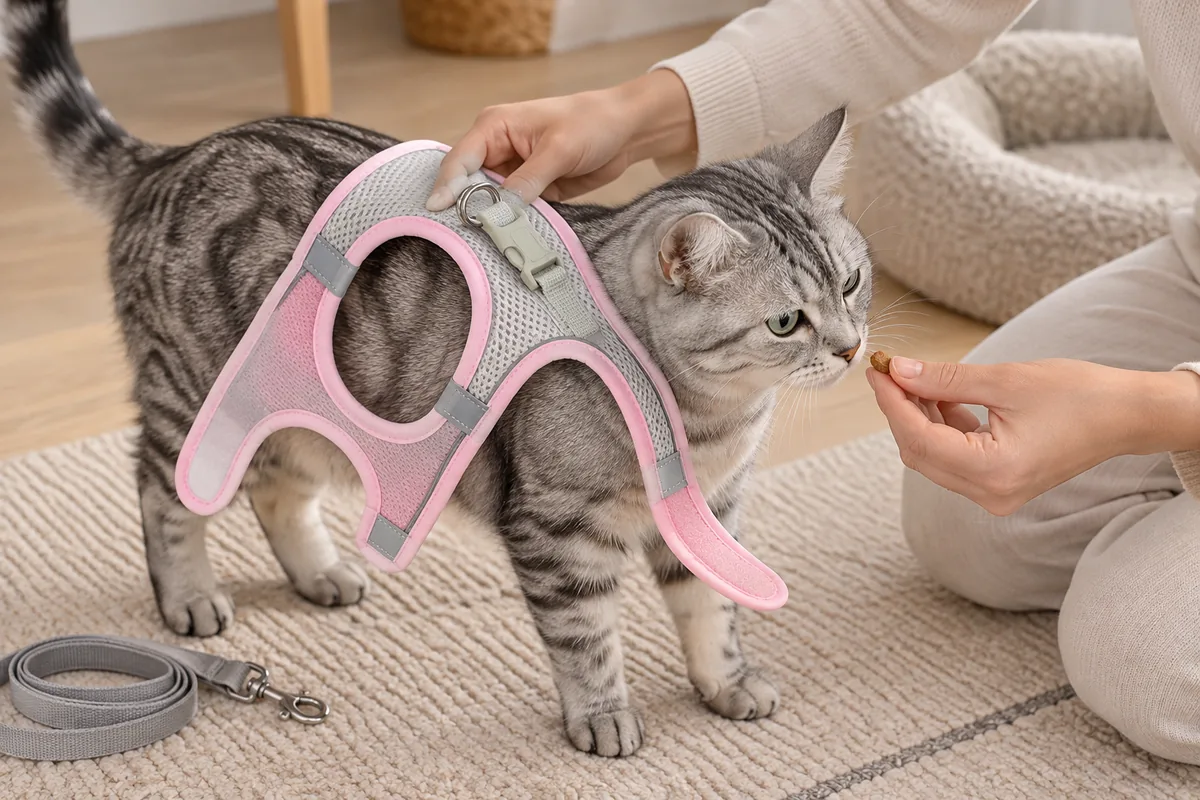
Lay the open vest over your cat's back for a second or two, treat, and remove it. Keep every repetition brief and end while your cat is still calm. Over several sessions, stretch the drape from seconds to half a minute.
Stage 4: Fasten for seconds, then minutes
Close the harness, treat generously, and take it off before your cat has time to object. Add time gradually across sessions. Expect the flop, the statue freeze, or a few backward steps at this stage. All of it is normal, and all of it fades. Our guide to putting on a cat harness breaks down the fastening motion itself.
Stage 5: Wear it through daily life
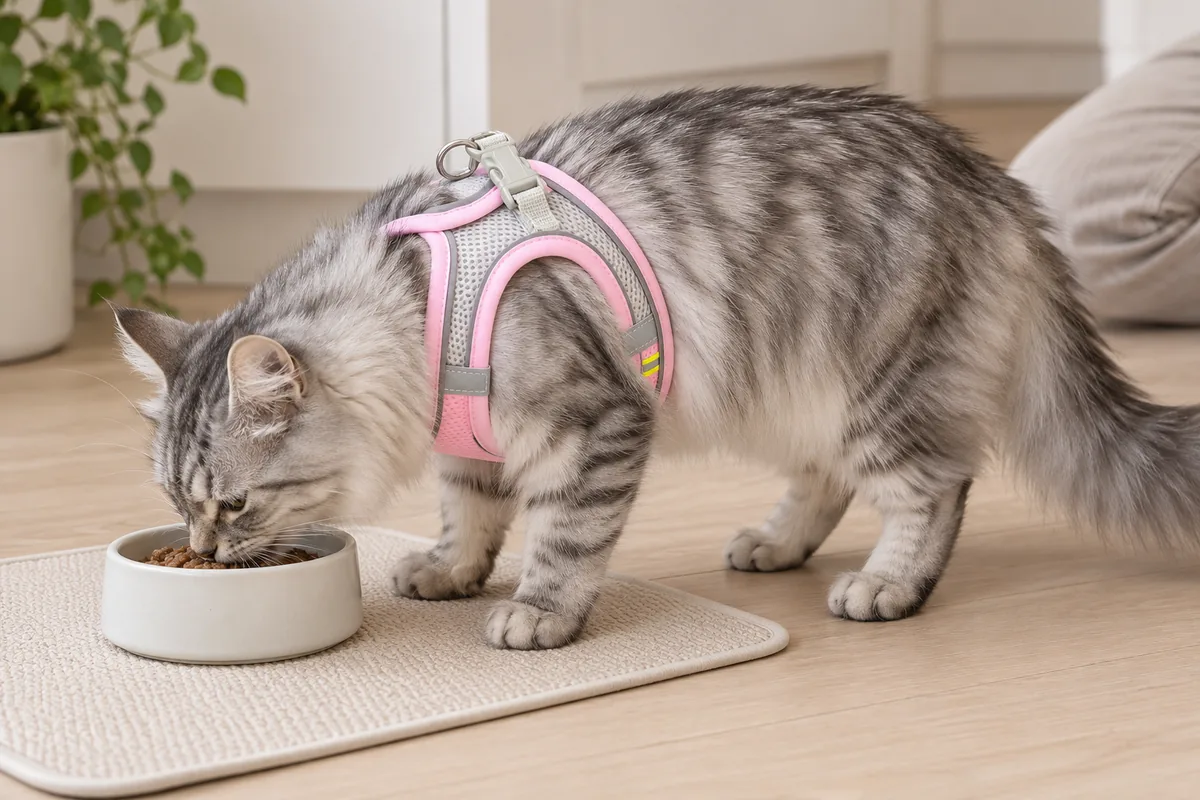
Once your cat tolerates a fastened harness, feed meals in it, play wand games in it, and let it become part of ordinary routines for ten to fifteen minutes at a time. When your cat walks, eats, and plays normally in the vest, indoor training is done. Kittens usually move through these stages fastest, which is why our kitten harness page recommends starting young if you can.
Stress signals that mean pause
Freezing, flattening to the floor, a tucked tail, airplane ears, dilated pupils, and refusing treats all mean the session is over. Take the harness off calmly, end on a neutral note, and try again tomorrow at an earlier stage. Forcing a frightened cat sets training back by weeks.
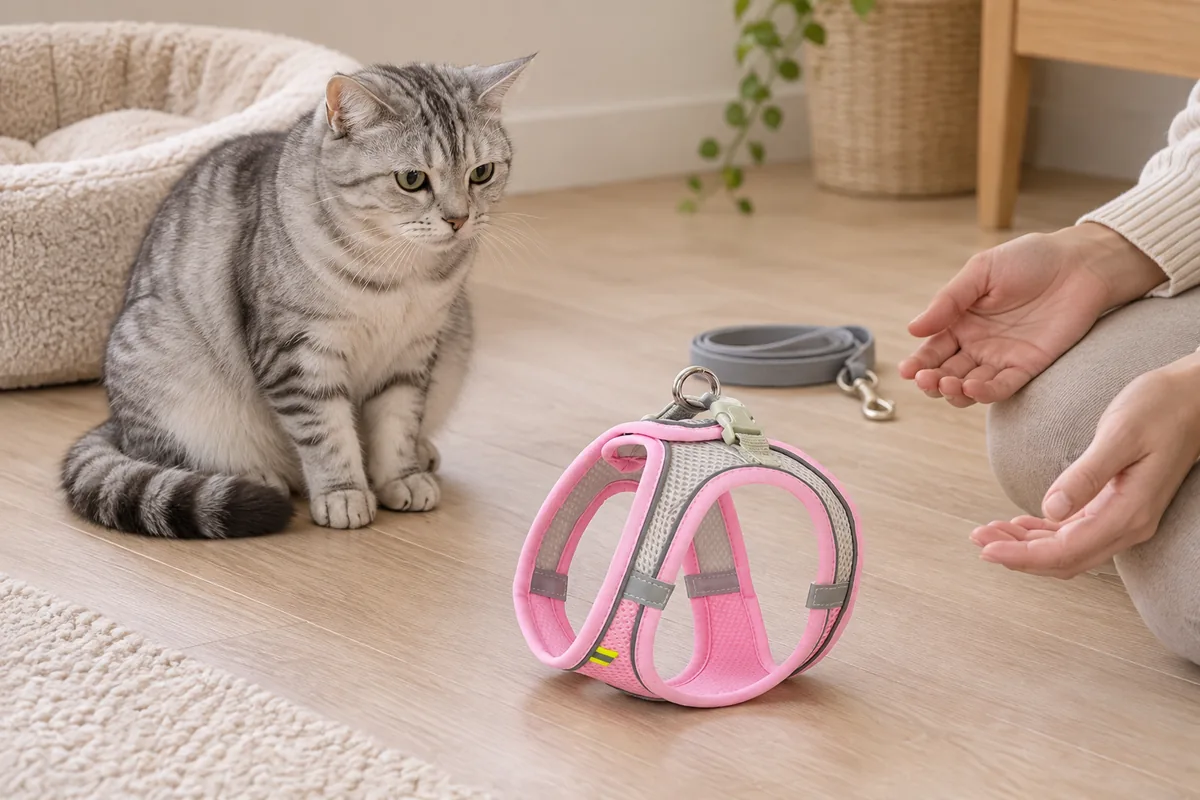
Refusing a favorite treat is the clearest signal on that list. A relaxed cat almost never turns down food it loves, so a refusal tells you stress has crowded out appetite. Do not talk your cat through it or hold the vest in place a little longer to finish the rep. End the session as if nothing happened.
Never forcing is not just kindness. It is strategy. A cat that learns the harness predicts being restrained will fight the vest for months. A cat that learns the harness predicts treats and calm handling will start climbing into your lap when it appears. The slow path is genuinely the fast path here.
How long it takes, by temperament
Most cats accept a harness in one to four weeks of short daily sessions. Confident, food-motivated cats often get there in days. Cautious cats need two to four weeks. Skittish or older cats can take six weeks or more, and that slower pace is completely normal.
| Temperament | What you will see | Typical timeline | Session length |
|---|---|---|---|
| Confident and food-driven | Curiosity, quick recovery from the flop | 3 to 10 days | 3 to 5 minutes |
| Cautious but curious | Slow approach, occasional freezing | 2 to 4 weeks | 2 to 4 minutes |
| Skittish or senior | Hiding, long pauses between stages | 4 to 8 weeks or more | 1 to 3 minutes |
My three cats covered that whole table. The bold one wore her vest to dinner within a week. The shy one needed six weeks of stage 3 alone before she would eat with the vest draped over her shoulders. Both of them now wait by the door. Larger breeds are often on the slower end simply because they are more deliberate, and our cat harness for large cats page covers their extra fit considerations.
Whatever the temperament, keep sessions daily. Ten quiet minutes every evening beats an ambitious half hour on weekends, because the cat's memory of the vest never has time to fade between reps.
Gear that makes training easier
A soft mesh vest with wide coverage is the easiest style for training because it spreads pressure and feels less like a trap than thin straps. Look for a dual closure, a sturdy leash ring, and sizing by weight, and always size up between two sizes.
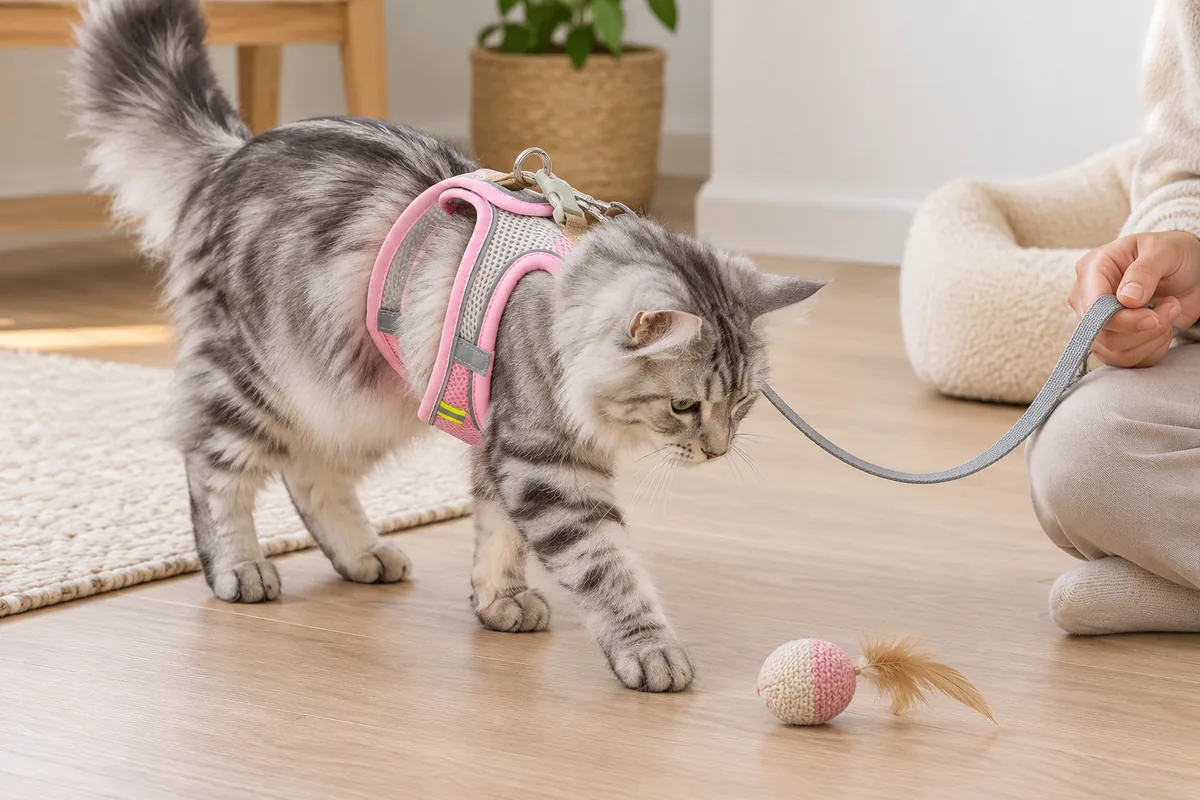
Fabric matters more during training than at any other time, because your cat is forming its first impression. Breathable mesh with padded edges reads as clothing rather than restraint. Strap-style designs concentrate pressure on thin lines across the chest, which is exactly the sensation nervous cats object to. Our best cat harness guide compares the main types without the marketing noise.
A note on the Escapaw escape-resistant harness: the velcro rip is the sound most likely to startle a cat, so open the closures in another room before each session. The dual velcro plus buckle closure also lets you drape the open vest flat in stage 3 without anything dangling.
Whichever harness you choose, pair it with a light leash from day one of stage 5 so the small tug of a dragging line becomes familiar indoors. The cat harness and leash page explains why a matched set removes one more variable. Real training stories from other owners live in the verified reviews.
Keep reading: once your cat wears the vest like a second coat, our answer to whether cat harnesses are escape proof is the next thing to read before you reach for the door handle.
Free shipping · 30-day returns