How we test our cat harness
Five criteria decide whether a cat harness keeps a cat contained and comfortable. Here is each one, and how the Escapaw vest answers it.
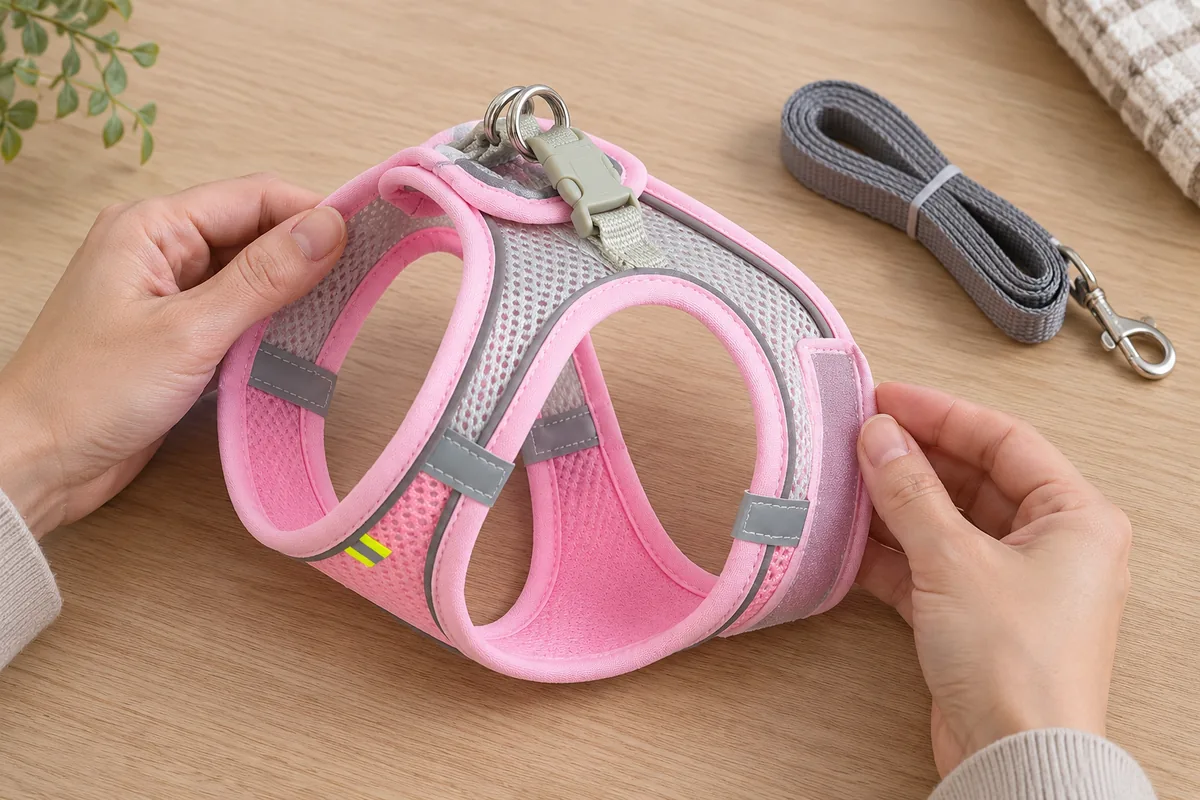
Escapaw is one product: a mesh vest cat harness with a matching 150 cm (about 5 ft) leash. It closes with a velcro panel and a clip buckle locked over it, anchors the leash to a reinforced metal D-ring, weighs 69 to 90 g depending on size, and carries reflective strips for dusk walks.
Putting it on and taking it off
A harness a cat hates to put on never gets used, so dressing comes first. The Escapaw vest lays flat, takes each front paw through its own leg opening, and closes over the back with velcro before the buckle clip snaps shut. Taking it off matters just as much: release the buckle and the velcro peels open in one motion, with no straps to thread back through. How to put on a cat harness walks through the exact sequence.
Stitching, buckle, and D-ring
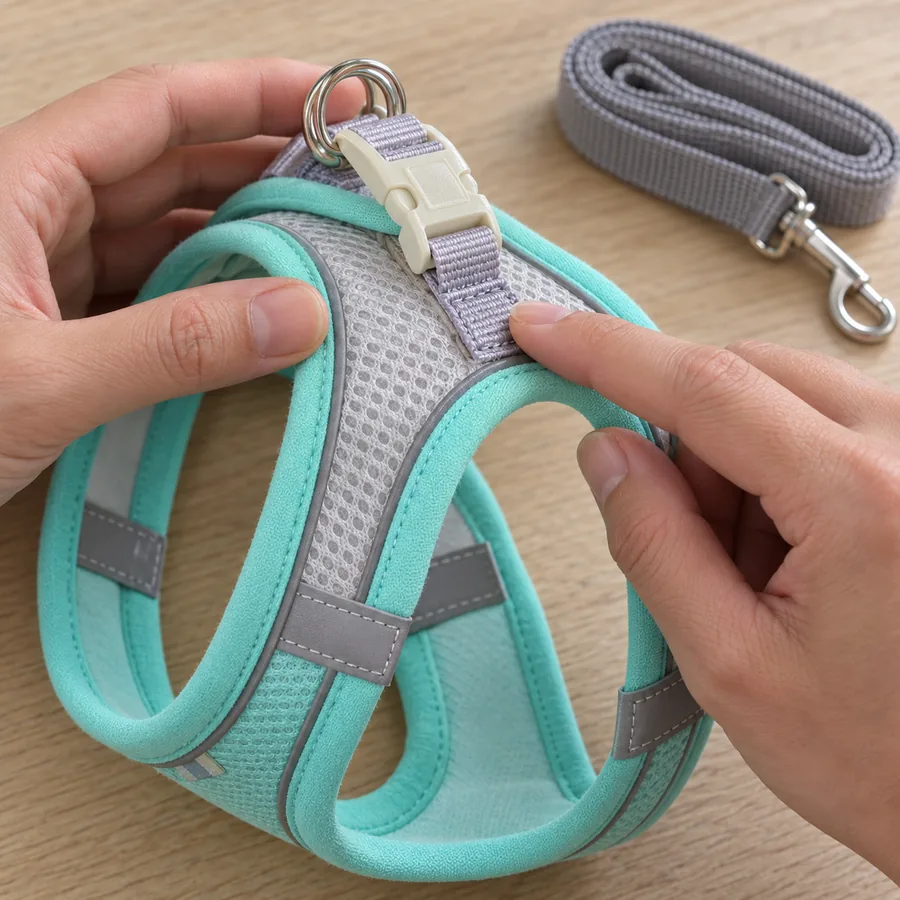
The leash ring takes every lunge your cat ever makes, so on the Escapaw vest it is reinforced metal rather than molded plastic, stitched through the back of the vest between the shoulder blades. The buckle clip locks over the velcro panel, and the padded edges sit soft against fur wherever the vest touches the legs and chest.
The velcro and clip together
The double closure is the heart of the escape-resistant design. Velcro alone can peel under a twisting cat; a buckle alone leaves a gap if the fit is loose. Closed together, the buckle clip locks over the velcro panel, so the vest cannot peel open from a backward pull: the buckle has to be released first. Press the full width of the velcro panel closed before you snap the buckle, because a half-closed strip is the easiest way to lose that protection.
In numbers: two independent closures (velcro panel plus buckle clip), one reinforced metal D-ring, five sizes covering an 11-24.4 in chest.
Staying centered on a real walk
A walk brings the situations that actually defeat harnesses: a sudden noise, a crouch-and-reverse, a lunge at a bird, a squeeze under a bush. The wrapping vest spreads the pull across the chest and shoulders instead of a narrow band, so there is no loose loop to reverse out of, and the reflective trim catches light at dusk. How to harness train a cat and the first walk outside guide prepare your cat for those moments.
Five criteria for a cat harness
These five decide whether a harness does its job.
- Closure security. The velcro panel and buckle clip must both engage fully and stay engaged through leash pressure from any angle.
- Fit range. Each size must adjust snugly across its full chest range, XXS 11-11.8 in through L 20.1-24.4 in, with no gap at the shoulders.
- Comfort signals. The mesh must stay breathable and the padded edges must not rub, because a cat that fights the harness never gets walked.
- Hardware strength. The buckle and the metal D-ring must hold a firm adult tug without flexing, cracking, or bending open.
- Visibility. The reflective strips must return light at dusk, when most close calls happen.
The best cat harness guide compares harness types on the same criteria, and the kitten harness and cat harness for large cats pages cover sizing at each end of the range.
The guarantee
No harness is 100% escape proof, so every walk should be a supervised walk. Every order of the cat harness and leash set ships free in the US, dispatches within 1-2 business days, arrives in 6-10 business days, and carries 30-day returns, detailed on our refund policy page. For the brand story, read about Escapaw.