· Erin Calloway
How to Put on a Cat Harness
Putting a harness on a cat should take about twenty seconds. When it takes five minutes and ends with a cat under the bed, the problem is almost never the cat. It is usually the order of operations, a closure fastened over fur, or a human moving too fast.
After eight years of daily walks with my three cats, the routine below is automatic in our house. It is written for the mesh vest style with a velcro panel and a buckle clip, which is the easiest design for wiggly cats and nervous humans alike.
Know your harness before you start
A mesh vest harness has three working parts: a velcro panel that wraps the body, a buckle clip that locks over it, and a metal D-ring on the back for the leash. Open both closures fully before you approach your cat, so the vest goes on in one smooth motion.
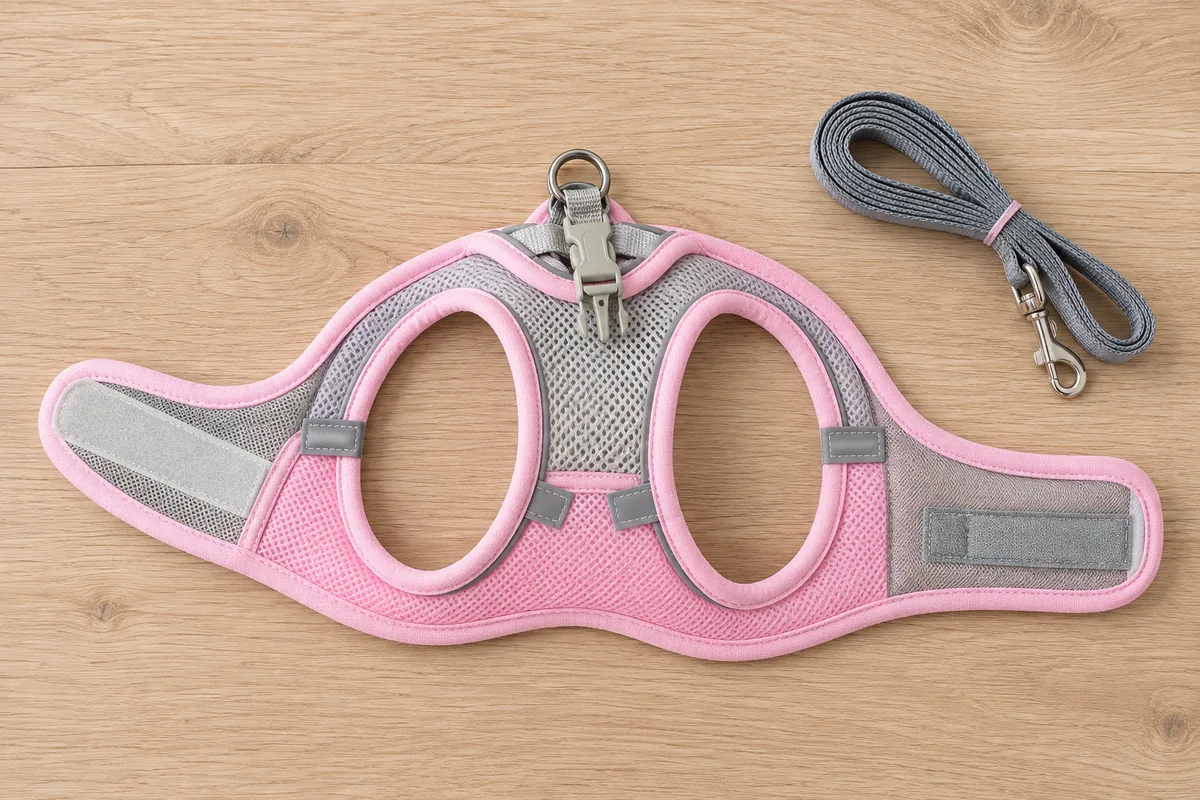
Spend one minute handling the empty vest before the first attempt. Practice opening the velcro slowly so it peels rather than rips, and snap the clip a few times so your fingers know the motion. Fumbling with an unfamiliar buckle while a cat squirms under your other hand is how most first attempts fall apart.
of U.S. households own a cat, 76.3 million pet cats in total, so millions of owners are learning this exact routine
— AVMA Pet Ownership Sourcebook, 2025
Note which edge of the vest is the neck opening and which panel wraps the chest. The shorter edge sits at the neck, the longer panel passes under the body, and two oval openings are cut into the panel itself, one for each front leg. Knowing the orientation by feel means you never hover over your cat rotating the vest like a puzzle piece, and the whole process stays boring. Boring is the goal, and if the vest itself is still scary to your cat, run the desensitization stages in our harness training guide first.
Putting on the harness, step by step
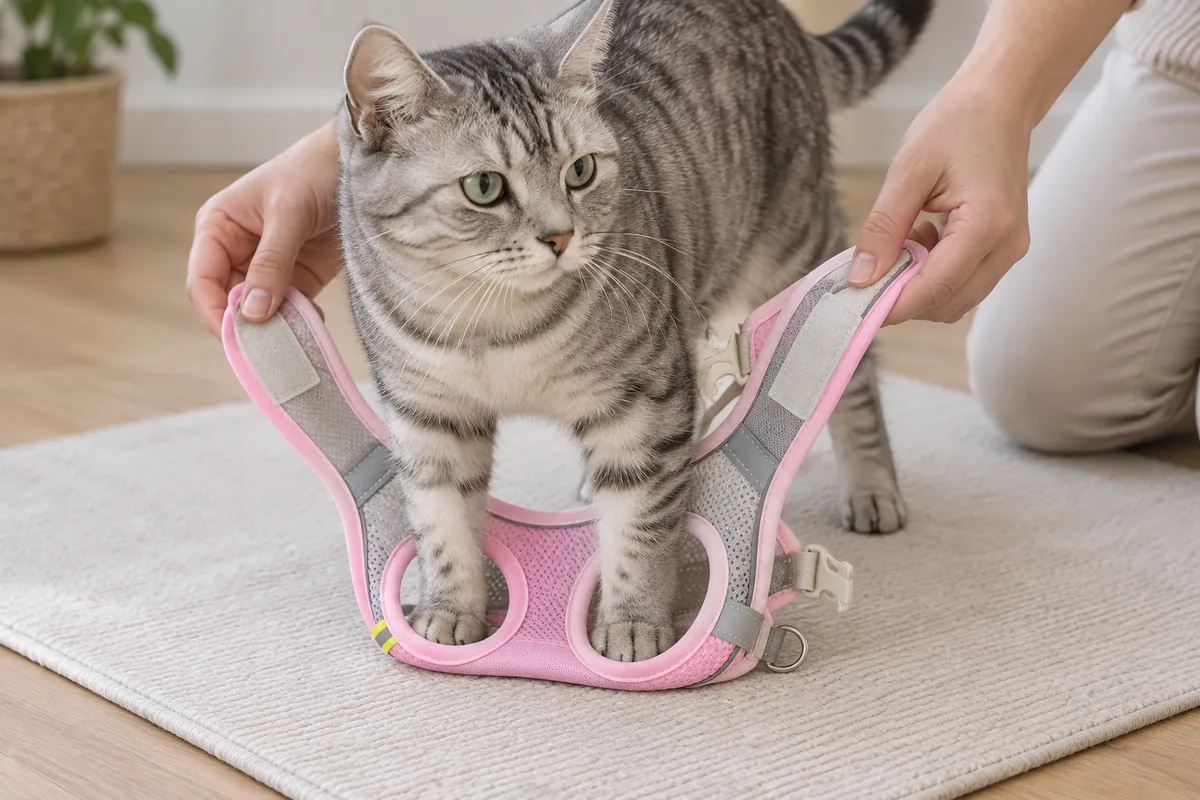
Let your cat sniff the open harness, lay it flat on the floor, guide one front paw through each of the two oval openings, bring the panel up over the back, press the velcro closed, then snap the buckle clip. Attach the leash to the D-ring only after both closures are flat and even.
Step 1: Set the scene
Wait for a calm moment, ideally before a meal when food motivation is high. Kneel beside your cat on the floor rather than lifting it onto a table. Keep treats within reach of one hand.
Step 2: Offer a sniff
Hold the open vest out and let your cat sniff it for a second or two. This is a courtesy knock, not a negotiation. Cats handle familiar objects far better than ambushes.
Step 3: Paws through the two openings
Open both closures so the vest lies completely flat, then set it on the floor in front of your cat with the neck edge forward. Lift one front paw and guide it through the oval opening nearest you, then the other paw through the second opening. Each front leg has its own hole cut into the panel; nothing wraps behind the legs and nothing threads over the head. Bring the two sides of the panel up over the back once both paws are through.
Step 4: Close the velcro, then the clip
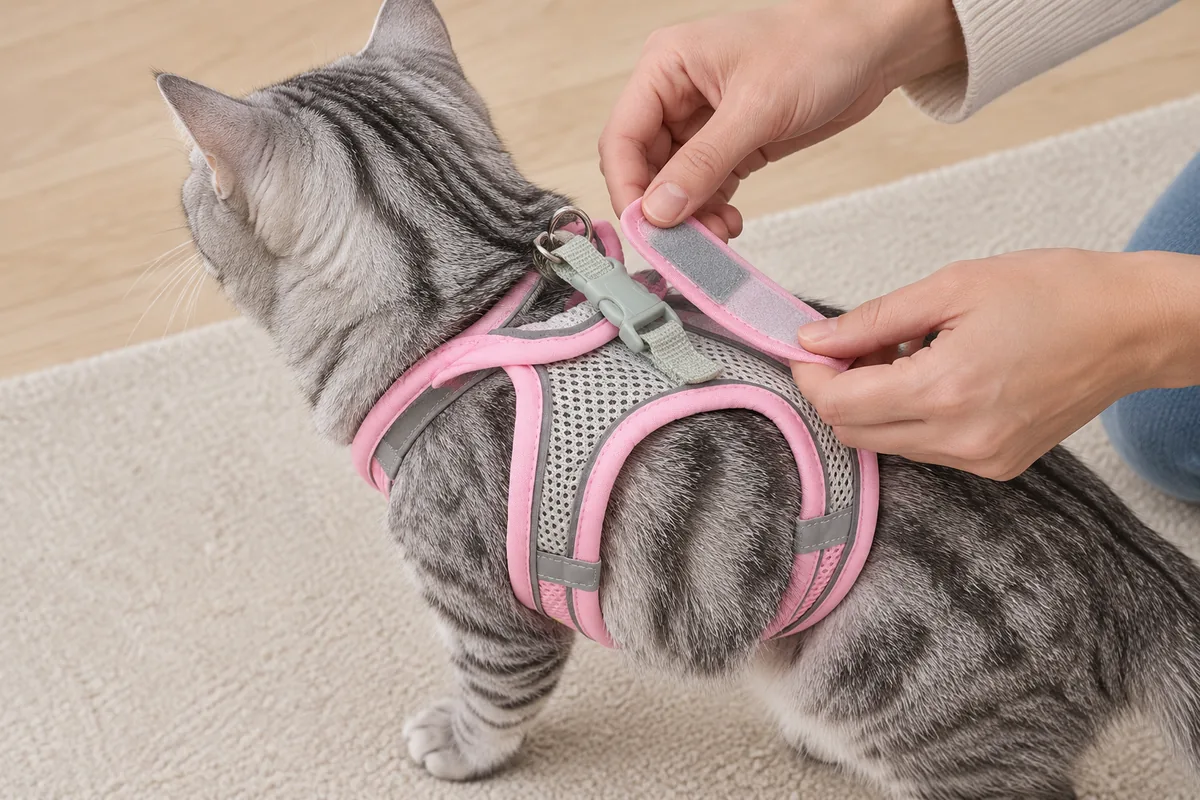
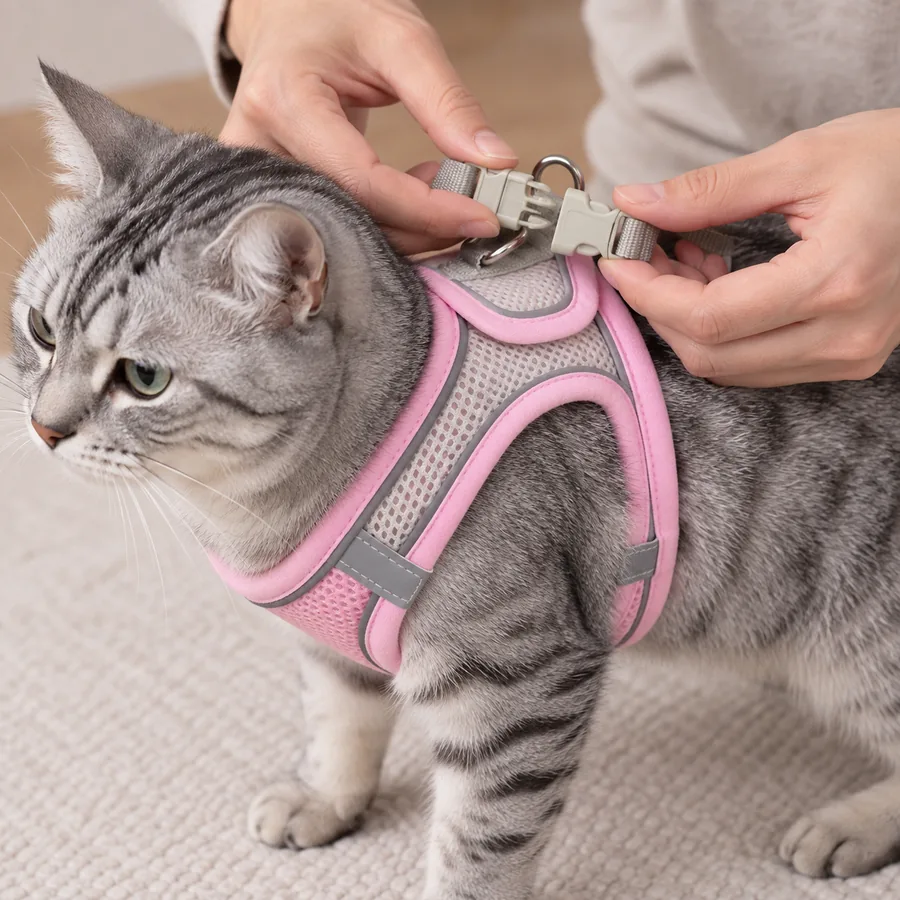
Bring the chest panel up under the belly and press the velcro flat along its full length, smoothing fur out of the way as you go. Then snap the buckle clip over it. The order matters: the velcro sets the fit and the clip locks it in. Treat immediately after the click.
Step 5: Check and attach
Run the two-finger check described below, then clip the leash to the metal D-ring on the back. Let your cat stand and take a few steps before you touch the leash at all. Handled this way, even an XS vest goes onto a squirmy kitten in under a minute, though young cats have their own quirks that our kitten harness page covers.
The two-finger fit check
Slide two fingers flat under the harness at the neck opening and again at the chest. Two fingers should fit snugly with no extra room. If it is looser than that, a cat can reverse out of it. If it is tighter, the vest digs in and teaches your cat to hate wearing it.
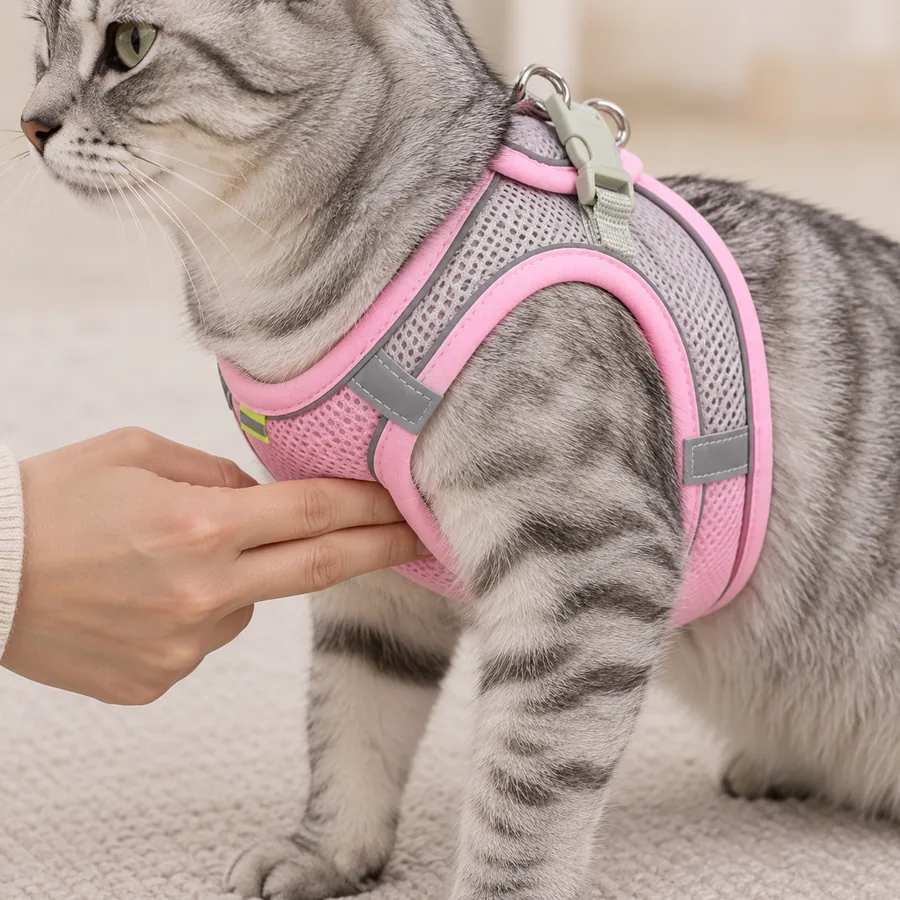
Run the check every single time you fasten the harness, not just the first week. Mesh relaxes slightly with wear, velcro creeps a few millimeters when it is fastened in a hurry, and cats change shape with the seasons. Twenty seconds of checking is what stands between a snug vest and a slipped one, which is the entire subject of our look at whether cat harnesses are escape proof.
Check both points separately. A vest can be perfect at the chest and loose at the neck, and the neck is exactly where a startled cat starts its reverse-out move. If you cannot make both points snug at once, the size is wrong, not the technique.
Common mistakes and how to fix them
The most common mistakes are fastening the velcro over fur, leaving the neck too loose, clipping the buckle before the panels sit flat, and chasing the cat around the room with the vest. Each one makes the next attempt harder, so slow down and reset calmly.
| Mistake | Why it matters | The fix |
|---|---|---|
| Velcro pressed over trapped fur | Weakens the hold and pulls fur with every step | Smooth fur down, then press the panel flat |
| Neck edge left loose | Gives a startled cat room to reverse out | Re-run the two-finger check at the neck |
| Clip snapped before velcro is flat | Locks in a crooked, uncomfortable fit | Always velcro first, clip second |
| Approaching from the front, over the head | Reads as a threat to most cats | Lay the vest flat on the floor and lift each paw into its opening |
| Chasing a retreating cat | Turns the vest into a pursuit cue | End the session and retry before the next meal |
One more habit worth building: put the harness on a few minutes before you actually need it. Fastening the vest and heading straight for the door teaches your cat that the harness always means the big scary outside. A short buffer indoors keeps the association calm, which pays off on the day of the first walk outside.
Choosing the right size first
Vest harnesses size by body weight. Weigh your cat, match the number to the size chart, and take the larger size whenever your cat sits between two. A vest that matches the weight range fits snugly out of the box and needs only small velcro adjustments.
| Size | Cat weight |
|---|---|
| XXS | 1.1 to 3.3 lb (0.5 to 1.5 kg) |
| XS | 3.3 to 6.6 lb (1.5 to 3 kg) |
| S | 6.6 to 13 lb (3 to 6 kg) |
| M | 13 to 22 lb (6 to 10 kg) |
| L | 22 to 33 lb (10 to 15 kg) |
Those are the four weight ranges the Escapaw escape-resistant harness comes in. A cat sitting right at the top of one range is the classic case for sizing up, because the velcro panel can snug a roomy vest down but cannot stretch a small one. The set arrives with a matching leash, which the cat harness and leash page covers in detail.
Weight-based sizing has one honest limit: two cats at the same weight can carry it differently. That is what the velcro panel is for, since it fine-tunes the wrap around your cat's actual shape. Long, heavy breeds deserve extra attention here, and our cat harness for large cats guide walks through their specifics. For a comparison of vest sizing against other harness styles, see the best cat harness guide.
If your cat flops, freezes, or reverses
Flopping over, freezing, or walking backward are normal first reactions to a new harness, not defiance. Take it off after a calm beat, shorten the next session, and pair every step with treats. Our harness training guide covers the full desensitization sequence step by step.
The one thing not to do is force the issue in the moment. Wrestling a resisting cat into a vest wins you one bad walk and costs you weeks of trust. Go back one stage, keep sessions under five minutes, and let food do the persuading. Plenty of owners describe their own first-week stories in the verified reviews.
Free shipping · 30-day returns