· Erin Calloway
Are Cat Harnesses Escape Proof?
We sell a harness with "escape proof" in our domain name, so this article has to earn its honesty up front. The phrase describes what cat owners search for, not a physics guarantee, and any brand that promises the guarantee is telling you something untrue.
What eight years of daily walks with three cats has taught me is more useful than a guarantee: escapes are predictable. They follow a known sequence, they exploit known weaknesses, and nearly all of them are preventable with the right style of harness fitted the right way.
Is there an escape proof cat harness?
No. Every honest maker will tell you that a determined, panicked cat can wriggle out of any harness ever made. What exists are escape-resistant designs: snug wrap-style vests with layered closures that make backing out far harder. Treat every walk as supervised time, never as a guarantee.
The stakes of a slipped harness are the reason this question deserves a straight answer. A cat that gets loose in an unfamiliar spot does not behave like a cat in its own yard. It bolts, hides, and stops responding to its name, and recovery is far from certain.
of lost cats were recovered by their owners, meaning one in four never made it home, in a national study of lost pets
The flip side is why harness walking is worth doing at all. The UC Davis School of Veterinary Medicine notes that indoor cats typically live 10 to 15 years while cats that roam outdoors average 2 to 5, and a leashed walk gives an indoor cat the outdoors without the roaming. The harness is the bridge between those two numbers, so it deserves to be chosen and fitted seriously, starting with proper harness training.
How cats actually get out of harnesses
Cats escape by reversing. When something startles them, they plant their front legs, drop the head and shoulders, and slide backward out of anything loose around the neck. Thin strap designs give a slipping cat leverage, while a loose fit of any style hands them the exit.
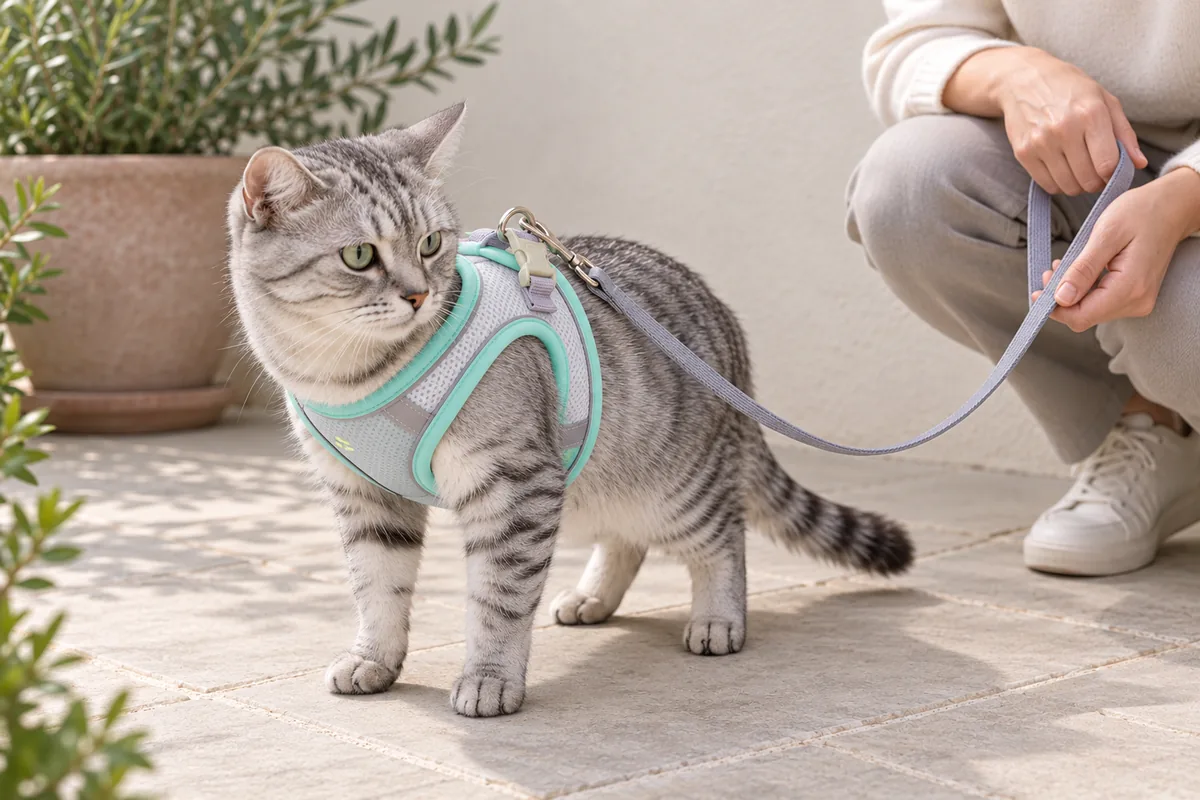
Watch a slipping cat in slow motion and the move looks rehearsed. The shoulders are the widest point a harness has to hold, and a cat can fold them inward to a startling degree. Once the shoulders clear the neck opening, the rest of the vest slides off in under a second. Strong, heavy cats generate the most leverage in that move, which is one reason our cat harness for large cats guide is so focused on fit.
Almost every escape starts with slack. A neck opening that admits three fingers instead of two is not slightly loose. It is an open door that has not been used yet. That is why the two-finger check in our guide to putting on a cat harness is a before-every-walk ritual rather than a first-day task.
The trigger is almost always a startle: a truck's air brakes, a door slam, a loose animal appearing from nowhere. The cat does not decide to escape so much as its body executes the reverse automatically. You cannot schedule startles, so the harness has to be ready for them at all times.
What makes a harness escape-resistant
Three things do most of the work: broad vest coverage that leaves no thin strap to slip, a dual closure that keeps a failure in one fastener from opening the whole vest, and a solid metal leash ring that will not bend under a sudden lunge.
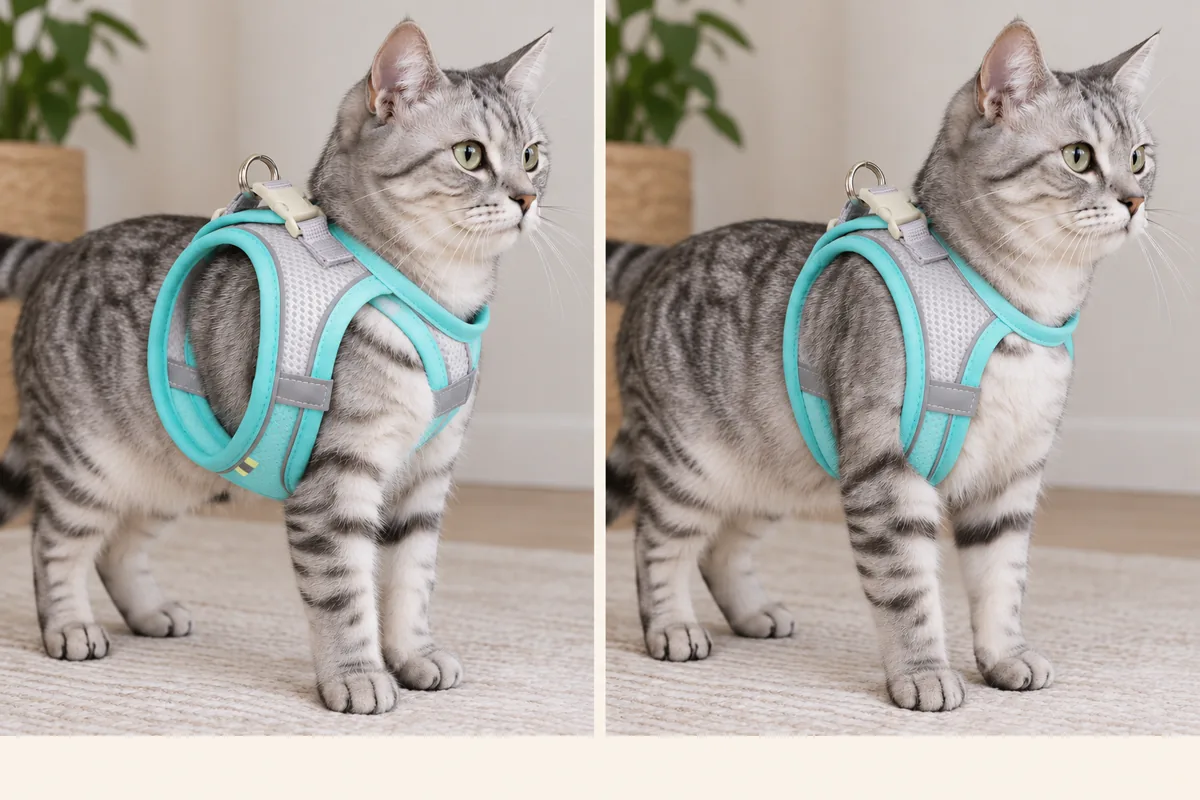
Coverage is the quiet hero. A wrap-style vest holds the torso across a wide band of fabric, so a folding shoulder meets resistance along its whole surface instead of slipping past one thin strap. The same coverage spreads leash pressure, which keeps a startled cat from associating the harness itself with a painful jolt, and it is the reason a leash belongs on a vest rather than on a neck strap, as we explain in cat harness vs collar.
This is the one section where our own product belongs in the story. The Escapaw harness is a mesh vest built to stop accidental escapes: a velcro panel sets the fit, a buckle clip locks over it so no single fastener is ever the only thing holding the vest, and the leash attaches to a reinforced metal D-ring. And still: no cat is 100% Houdini-proof, so supervise every outdoor minute. The verified reviews put the rating at 4.8 out of 5 across 186 reviews.
Whatever brand you buy, apply the same three-part test: wide fabric coverage, two independent closures, metal at the leash point. Our best cat harness guide runs every common harness type through exactly that filter, type by type rather than brand by brand.
How to make a cat harness escape proof, or close
You cannot make any harness truly escape proof, but you can remove almost every real-world failure point: size by weight, run the two-finger check at the neck and chest before every walk, inspect the closures weekly, and walk in calm places where panic is unlikely.
Sizing comes first because no ritual fixes a wrong size. Match your cat's weight to the size chart and take the larger size when the number sits between two. Kittens deserve special mention here, since they outgrow a snug fit in weeks, and our kitten harness page explains how often to re-check a growing cat.
| Check | How | How often |
|---|---|---|
| Two-finger fit at neck and chest | Two fingers flat under the edge, snug, no more | Before every walk |
| Velcro hold | Peel test: the panel should resist a firm tug | Weekly |
| Buckle clip | Snap it, then squeeze-test the latch | Weekly |
| D-ring and stitching | Look for bent metal or loose threads at the anchor | Monthly |
| Leash clasp | Open and release, confirm it springs shut | Weekly |
The last failure point is the environment. A perfectly fitted harness on a calm cat in a quiet yard has almost nothing to defeat it, while the same harness at a loud intersection is being stress-tested every minute. Route choice is part of escape prevention, and our first walk outside guide is largely a guide to choosing low-panic settings.
If your cat backs out or starts to slip
Do not chase. Crouch low, stay quiet, and let your cat pause, since most bolt only a short distance and hide. Use treats or a familiar carrier to draw them back. If the harness is half off, guide your cat against your body before touching the vest.
The half-slipped harness is the moment most owners get wrong. Grabbing at the vest while it hangs off one shoulder pushes a stressed cat into finishing the escape. Instead, scoop your cat against your chest first, control the body, and deal with the fabric afterward. If you are close to home, walk straight inside before adjusting anything.
Afterward, treat the slip as data. Find the slack that made it possible, re-run the fit checks, and go back to short sessions somewhere quiet, because one scare can make a previously relaxed walker cautious for weeks. A few days of hallway walks with the harness and leash set, generous treats, and patience will rebuild the routine faster than pretending it did not happen.
Free shipping · 30-day returns