· Erin Calloway
Cat Harness vs Collar
The question turns up the moment someone buys a first leash for a cat. The collar is already on, it already has a ring hanging off it, so why buy anything else? That ring holds a tag, not a cat. Nothing below argues for taking the collar off.
What each piece of gear is for
A collar is an identification carrier. It holds a tag, a bell, sometimes a tracker, and it is built to sit lightly on the neck all day. A harness is load-bearing gear, made to take the force of a leash and spread it across the chest, ribs and shoulders.
Those two jobs pull in opposite directions. Identification wants something light, loose enough to be forgotten, and quick to abandon if it catches on a fence post. Leash work wants the reverse: gear that will not shift, will not open, and will not funnel force anywhere delicate.
Vocabulary makes this harder than it needs to be. Plenty of owners call anything that goes around a cat a collar, our own buyers included. One verified review of this vest opens with that exact word: "The collar is light and comfortable to wear on the cat, not difficult to close at all." She is describing a mesh harness.
Where the pull lands: throat or chest
On a collar, leash force arrives at a narrow band around the neck, sitting over the windpipe. On a vest, the same force enters at a ring between the shoulder blades and spreads across the whole torso. Identical pull, completely different anatomy absorbing it.
Shelter guidance is consistent about the attachment point. The San Francisco SPCA reduces it to one line in its cat leash training handout:
"The leash attachment should be located on the back of the harness, not at the neck."San Francisco SPCA, Cat: Leash Training
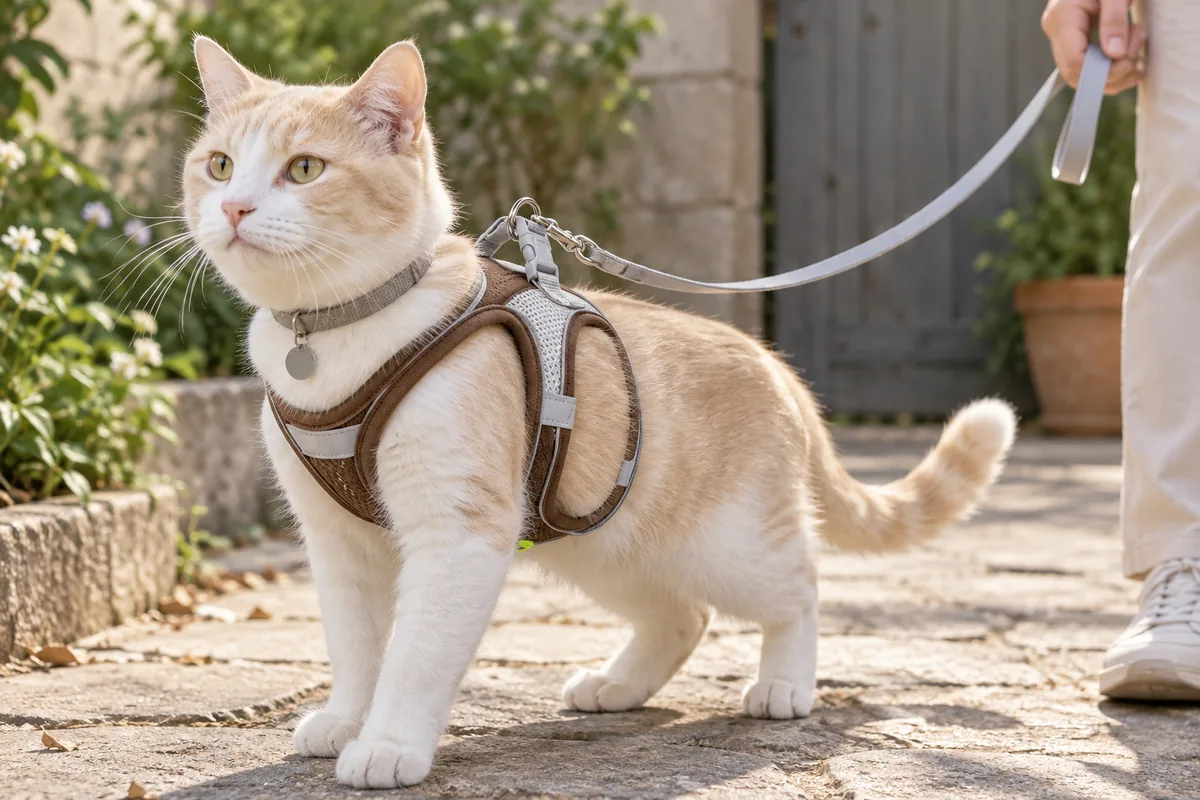
Cats also do not pull the way dogs do. A dog leans into a leash steadily and you feel it build. A cat stands still, then is gone, so a 9 lb (4 kg) body arrives all at once.
That does not mean a collar injures a cat every time the leash goes tight. It means you are repeatedly loading a structure never meant to carry load. Coughing, gagging, or a cat that plants itself the instant the leash tightens are the mild everyday versions. Moving the anchor eight inches back removes the question instead of managing it.
The breakaway problem: a safe cat collar is built to let go
The safest collars for cats are breakaway or elastic, so a cat snagged on a branch can free itself. That release is a real safety feature, and it is also the reason a collar cannot anchor a leash. The moment you most need it to hold is the moment it is engineered to open.
This turns the usual argument inside out. A rigid collar that refuses to release is the only kind strong enough to take a leash, and it is also the kind that can trap a cat who catches it on a fence while you are at work. A breakaway collar erases that risk and hands you a different one: it pops open under a hard pull, usually near a road.
So the collar question is not safe against unsafe. It is a choice between one that holds and can hurt, and one that protects and will not hold. Both are wrong for walking.
What the collar research shows
Two studies are worth knowing. In a six-month trial of 538 cats fitted with collars, just under three quarters kept the collar on the whole time. In a separate owner survey, roughly a quarter had seen a collar incident, though injuries needing a vet were rare.
of 538 cats kept their collar on for the entire six-month study, meaning more than one in four did not
— Lord, Griffin, Slater & Levy, Journal of the American Veterinary Medical Association, 2010
of the cats in that same trial caught a forelimb in the collar, or caught the collar on an object or in their mouth
— Lord, Griffin, Slater & Levy, Journal of the American Veterinary Medical Association, 2010
of 63 surveyed cat owners had experienced a collar incident over a lifetime of ownership, injuries requiring treatment being rare
— Calver, Adams, Clark & Pollock, Animal Welfare 22(1), 2013
Read those figures carefully, because they are not a case against collars. Calver and colleagues concluded the opposite for roaming cats, that traffic and fights are far greater hazards. The retention number is the one that matters here: collars come off, by design and by accident, and that is not something to build a walk around.
Harness vs collar, side by side
The two differ on every axis that matters for a leash: the job each was designed for, the surface taking the force, and what happens under a hard pull.
| Breakaway collar | Cat harness | |
|---|---|---|
| Designed to | Carry a tag, a bell, sometimes a tracker | Anchor a leash |
| Where force lands | A narrow band around the throat | Chest, ribs, shoulders and back |
| Under a hard pull | Releases, which is the point of it | Holds, provided the fit is snug |
| Contact area | About a finger's width | The full torso panel |
| Wear it | All the time, including indoors | Supervised walks and training only |
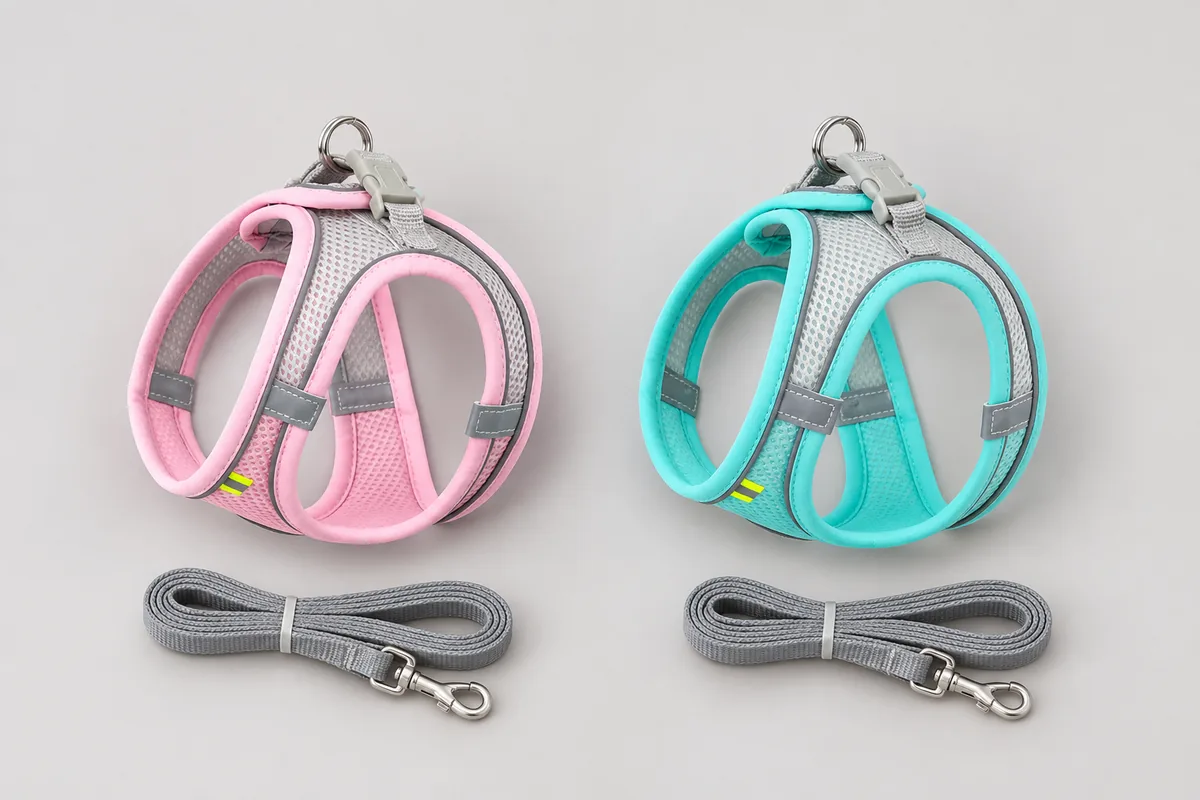
The flat lay makes the surface argument obvious: almost the whole shape is contact area, and the ring sits at the top, behind the neck rather than under it. Our best cat harness guide sorts the common types by coverage instead of by brand.
Does a harness make escape impossible? No
No harness is escape proof, ours included. A frightened cat can fold its shoulders and reverse out of almost any design carrying slack. A snug wrap-style vest with two independent closures makes that far harder, but it is not a guarantee and we will not sell it as one.
What a harness removes is the failure mode a collar cannot avoid. A fitted vest does not release on purpose, and it does not put the pull on the throat. The risk that remains is a fit problem, and fit problems can be fixed.
How cats perform that backward slip, why the shoulders are the weak point, and what to do in the first ten seconds after one gets loose are covered in our article on whether cat harnesses are escape proof. It also carries the full pre-walk check table, the weekly closure inspection, and the routine for rebuilding confidence after a scare.
The setup we use, and why it is two pieces
Breakaway collar on permanently for identification, backed by a microchip. Harness on for supervised walks, off afterward. The collar handles the day your cat gets out; the harness handles every day your cat goes out with you.
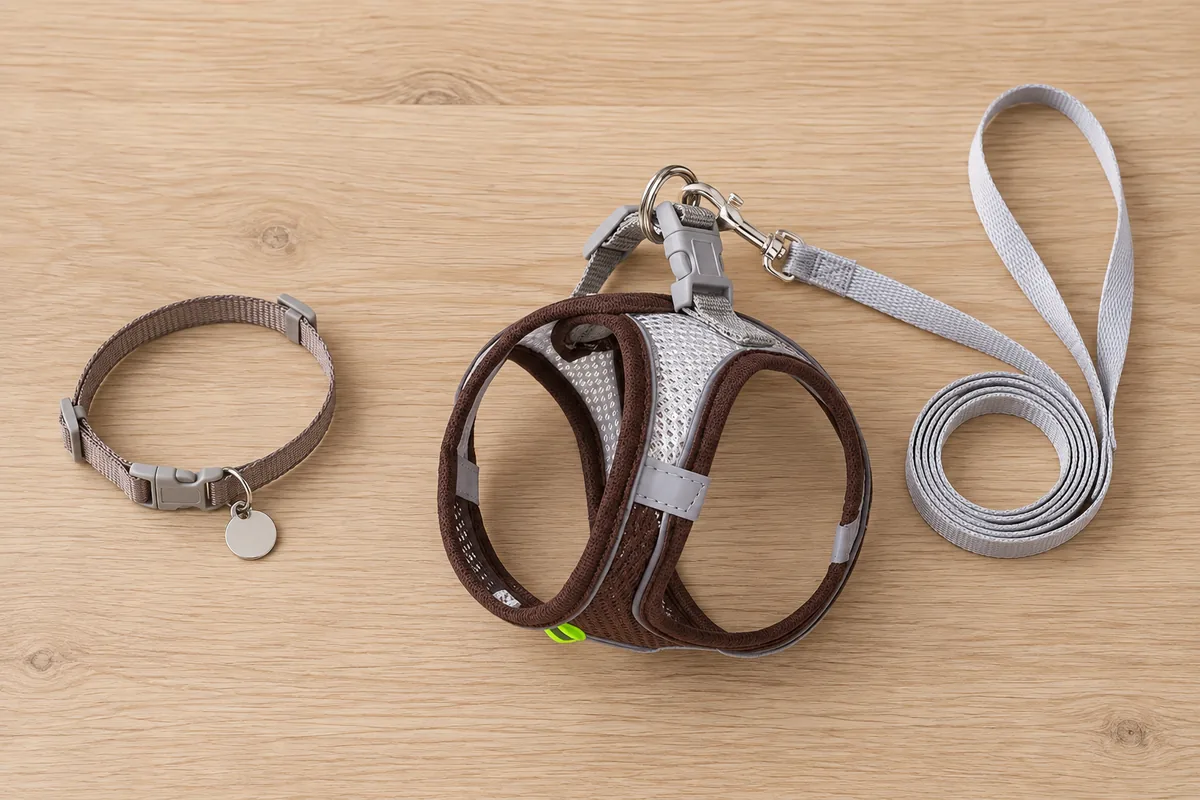
This is where our own product belongs in the story. The Escapaw harness is a breathable mesh vest with padded edges, closed by a velcro panel with a clip buckle locking over it, so no single fastener is ever the only thing holding it shut. The leash attaches to a reinforced metal D-ring between the shoulder blades, and a matching 150 cm (about 5 ft) leash comes in the box with every harness and leash set. The rating sits at 4.8 out of 5 across 186 reviews.
Order matters more than brand. Size by weight and chest measurement first, then teach the vest indoors over short sessions. Our guides on harness training a cat and putting on a cat harness cover both halves, and kittens get their own timeline on the kitten harness page. Keep the collar on through all of it: on the day something goes wrong, a stranger who finds your cat reads a tag long before anyone thinks to scan for a chip.
Cat harness vs collar FAQ
Can I clip a leash to my cat’s collar for a short walk?
We would not. A short walk is exactly when a startle happens, and on a collar the whole pull lands on a narrow band over the windpipe. A breakaway collar will also release under that force, which is what it was built to do.
Should my cat wear a collar and a harness at the same time?
Yes, that is the setup we use. The breakaway collar stays on for identification, carrying a tag with your phone number, and the harness goes on for supervised walks and comes off afterward. They do different jobs and they do not interfere with each other.
Is a harness safer than a collar for a cat that pulls hard?
For leash work, yes, and the difference grows the harder your cat pulls. A vest spreads the force of a lunge across the chest, ribs and back instead of concentrating it on the throat. It is still not escape proof.
My cat tolerates a collar but hates the harness. What now?
That is a training problem, not a gear problem. A collar is barely noticeable while a vest is a new sensation across the whole torso, so cats protest the second one first. Build it up in short indoor sessions before meals, over days rather than hours.
Free shipping · Dispatched in 1-2 business days, delivered in 8-10 · 30-day returns