· Erin Calloway
Can You Use a Dog Harness on a Cat?
The question is a practical one, not a lazy one. A harness is already in the house, it looks about the right size, and the packaging never said which animal it was for. What follows is what changes between the two bodies, and why it matters for the gear standing between your cat and an open street.
One word, two products
The word harness describes a job, not a shape. Gear sold for dogs is engineered around steady forward pulling from a broad, rigid chest. Gear sold for cats is engineered around a light body that stands still and then leaves sideways. Same job title, two different design problems.
A dog on a leash leans. The pull builds, you feel it in your arm, and the harness spreads that steady load across a wide chest, with webbing and buckles scaled to match. A cat does none of that. A cat walks, stops to consider a leaf, and then once in a while is simply gone in a direction you did not predict. There is no build-up to brace against, so the gear has a different task: stay closed through one violent instant, on a body weighing a fraction as much. Hardware that makes sense at eighty pounds is dead weight at nine, which is why the leash half of this mismatch gets its own treatment on the cat harness and leash page.
The anatomy that changes the fit
Three differences do most of the work. A cat's shoulder blade is not braced by a rigid collarbone, so the shoulders fold inward. The ribcage is narrow and deep rather than broad. And the body tapers sharply from chest to waist, so a circle that fits at one point is loose an inch further back.
The collarbone is the one that surprises people. In a cat the clavicle is small and is not locked into a rigid strut between shoulder and breastbone. The shoulder blades ride against the ribcage, held by muscle, which is why a cat can compress its front end and pour itself through a gap that looks far too narrow. It is the same trick that gets a cat through a fence rail, and a harness with slack in it is a fence rail with a leash attached.
The second difference is the cross-section. A cat's chest is deep from spine to sternum and narrow from side to side, closer to an oval standing on end than to a broad barrel. Padding that sits comfortably on one shape sits on bone on the other.
The third is the taper. Cats narrow quickly behind the ribcage, so a harness that closes correctly at the widest point of the chest may sit over a much smaller circumference two inches back. Any strap drifting into that zone immediately has room it should not have.
Where a dog harness opens up on a cat
The failure point is the space behind the front legs. On a cat wearing a harness cut for a broader animal, the chest strap sits away from the body instead of against it, leaving a pocket of slack. A startled cat plants its front feet, drops its shoulders and reverses straight through that pocket.
Escapes look dramatic but are very consistent. The cat does not chew, twist or fight the buckle. It backs up. The shoulders fold, the neck opening passes over them, and the harness is off in about a second, all of it running on slack that was there before the walk started. We take that sequence apart in are cat harnesses escape proof.
That slack is there by design rather than by accident: the neck opening is scaled to a thicker neck, the chest strap is positioned for a chest that stays wide further back, and the adjustment range often starts where a cat's requirements end. You can tighten it, and owners do, but tightening a strap in the wrong place only moves pressure somewhere that was never meant to carry it.
of lost cats were recovered by their owners in a national study of lost pets, meaning one in four never made it home
The cat who turns around inside the harness
Cats rotate. A cat that dislikes what is happening will spin inside a loose harness until the leash ring ends up under its chest instead of on its back. Once the anchor point moves, every pull arrives at the wrong angle and the harness stops working the way its designer intended.
This is the quieter failure, the one owners call the harness going crooked. The vest stayed put while the cat turned inside it, which a loose fit permits and a snug fit does not.
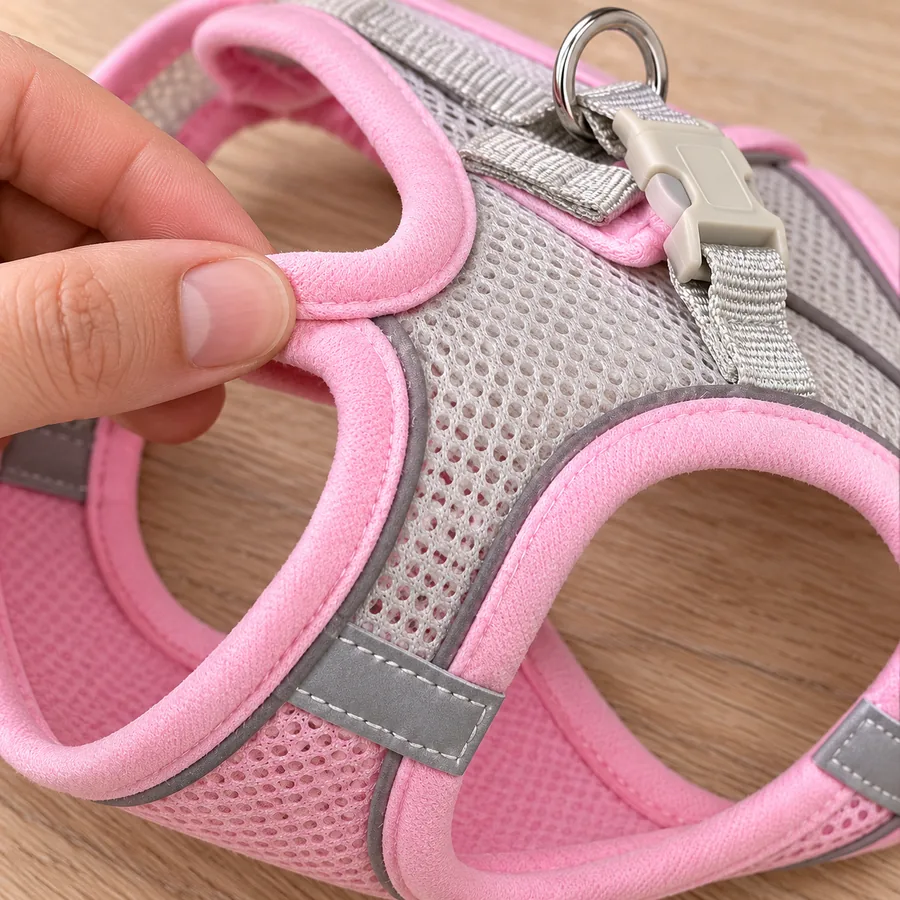
Rotation also undoes the one thing a back-mounted ring is for. Putting the anchor between the shoulder blades keeps a sudden lunge away from the throat, the argument for a harness over a collar that we cover in cat harness vs collar. Usefully, the fix is the same as for the gap: a harness close enough to the body not to rotate is also a harness with nothing to reverse out of.
What about a very small dog's harness?
This is the fair version of the question, and the answer is still shape rather than size. A harness cut for a four-pound dog solves the weight problem and leaves the geometry problem untouched, because it is still built around a different chest, a different neck ratio and a different taper.
The weight overlap is bigger than people expect, which is why sizing by the scale leads owners astray.
weight a mature male Maine Coon commonly reaches or exceeds, per the breed's official profile, well above many small dogs
— The Cat Fanciers' Association, 2025
Read that number next to a toy breed and the trap is obvious. If weight decided fit, a large cat and a small dog of the same weight could share gear. They cannot, because the harness is not holding weight. It is holding a circumference in a specific place, on shoulders that behave differently. Our cat harness for large cats guide covers that end of the range.
Small-dog harnesses also keep adult hardware on a reduced body, so the clasp, ring and buckle stay heavier than a cat needs. That weight drags a harness out of position, and out of position is where the slack appears.
The measurements that decide it
Three numbers settle a cat harness: weight, the neck at its base, and the chest at its widest point just behind the front legs. The chest measurement decides whether a cat can reverse out, so it is the one to take twice.
Take the chest with the tape flat against the coat, immediately behind the elbows, and do not pull it tight against a longhaired cat's fur; you want the body, not the compression. Take the neck at the base where a harness sits, lower than where a collar rides. Weigh the cat by holding it on a bathroom scale and subtracting yourself. Where the numbers disagree, size up.
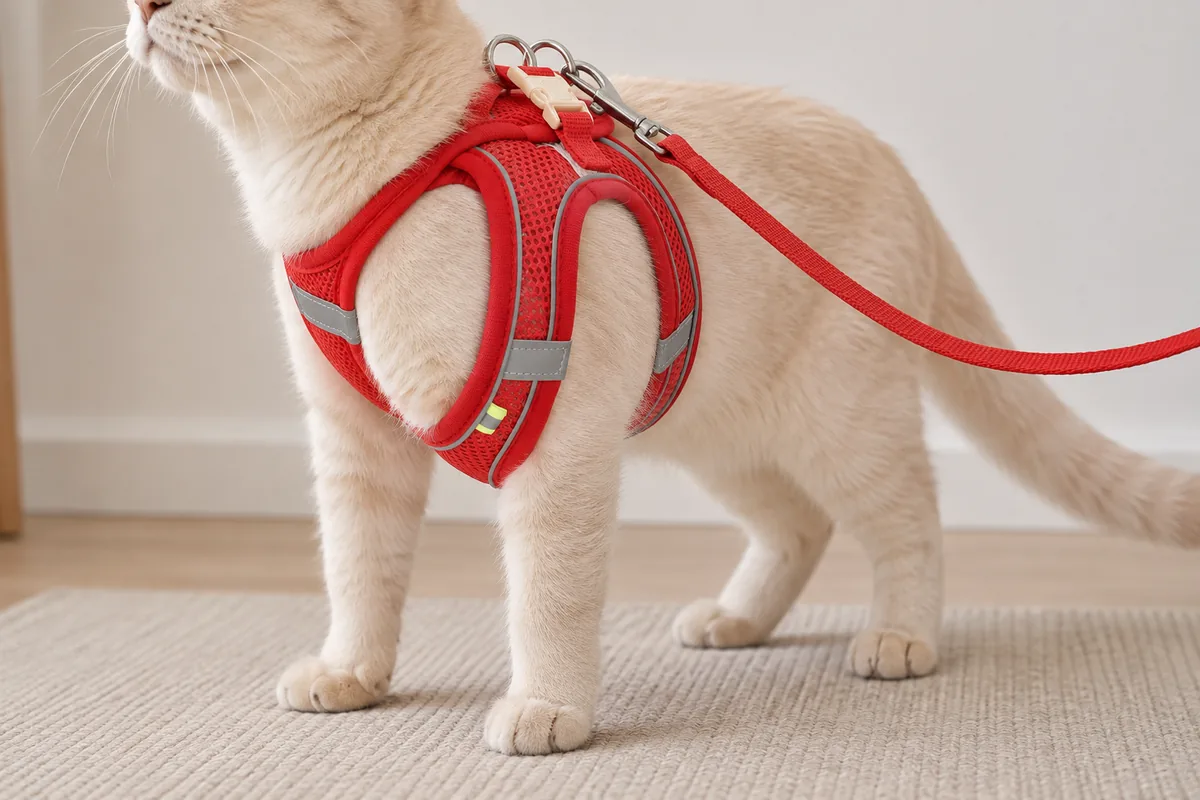
Then check the fit on the animal rather than on the tape. Two flat fingers should slide under the harness at the neck and at the chest, and a third should not. That check takes seconds, which is why it appears before every walk in our guide to how to put on a cat harness. Growing cats need it on a schedule, since a fit correct last month can be generous this month; the kitten harness page covers how often to re-measure.
What a cat-cut vest does differently
A harness designed around a cat starts from the failure modes above. It wraps instead of strapping, so there is no pocket behind the front legs, and it closes twice, so one fastener working loose does not open the vest. Everything else follows from those two decisions.
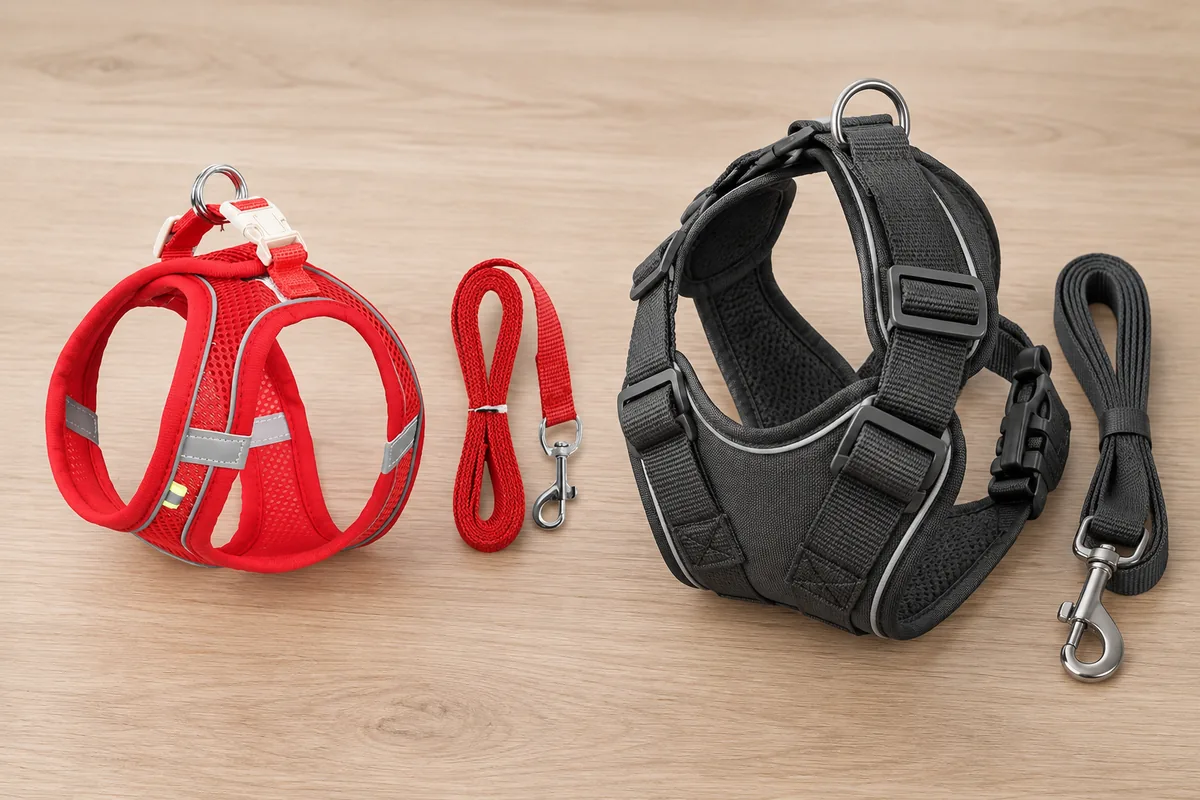
This is where our own product belongs in the story. The Escapaw harness is a breathable mesh vest with padded edges, built around the two choices above. It wraps the torso as a panel rather than crossing it with straps, which removes the gap a cat reverses through, and it closes with a velcro band that sets the circumference plus a buckle clip locking over it, so a peeled velcro corner alone still leaves the vest shut. The leash attaches to a reinforced metal D-ring between the shoulder blades. Five sizes cover 1.1 to 33 lb (0.5 to 15 kg), and the vest weighs 69 g in XS up to 90 g in L: the harness is not what your cat is carrying. The rating sits at 4.8 out of 5 across 186 verified reviews.
Verified reviews.
No harness is escape proof, ours included, so supervise every outdoor minute. And fit is the part that stays in your hands: a vest sized wrong is a vest with slack in it.
The real question was never whether a dog harness can be made to stay on a cat for one lap of the garden. It is whether it will still be there during the two seconds after something bangs. That is the test, and it is worth handing to gear drawn around a cat in the first place.
Dog harness on a cat FAQ
Can I put a dog harness on my cat just for one vet trip?
We would use a carrier for that trip instead. A vet parking lot is loud, unfamiliar and full of startles, the combination that finds every loose spot in a harness cut for another animal. If a harness has to hold, it should be one shaped for a cat and fitted before the day you need it.
My cat weighs more than my neighbour's small dog. Does the same harness fit both?
No. Two animals can hit the same number on the scale and still need different harnesses, because chest depth, shoulder width and the taper behind the front legs are what a harness has to follow.
Is a dog harness actively dangerous for a cat, or just a poor fit?
The realistic risk is escape rather than injury. A harness hanging loose at the shoulders gives a startled cat the slack it needs to reverse out, usually outdoors. Treat it as a fit problem with an outdoor consequence.
My cat wears a dog harness now and has never escaped. Should I change anything?
Run the two-finger check at the neck and the chest before the next walk. If either spot takes more than two flat fingers, the harness carries slack your cat has not needed yet. Cats escape on the day something bangs, so close that margin while nothing is going wrong.
Free shipping · 30-day returns